Category: Data Strategy

  • Why your CFO will ask about AI lineage before they ask about AI accuracy

    Why your CFO will ask about AI lineage before they ask about AI accuracy

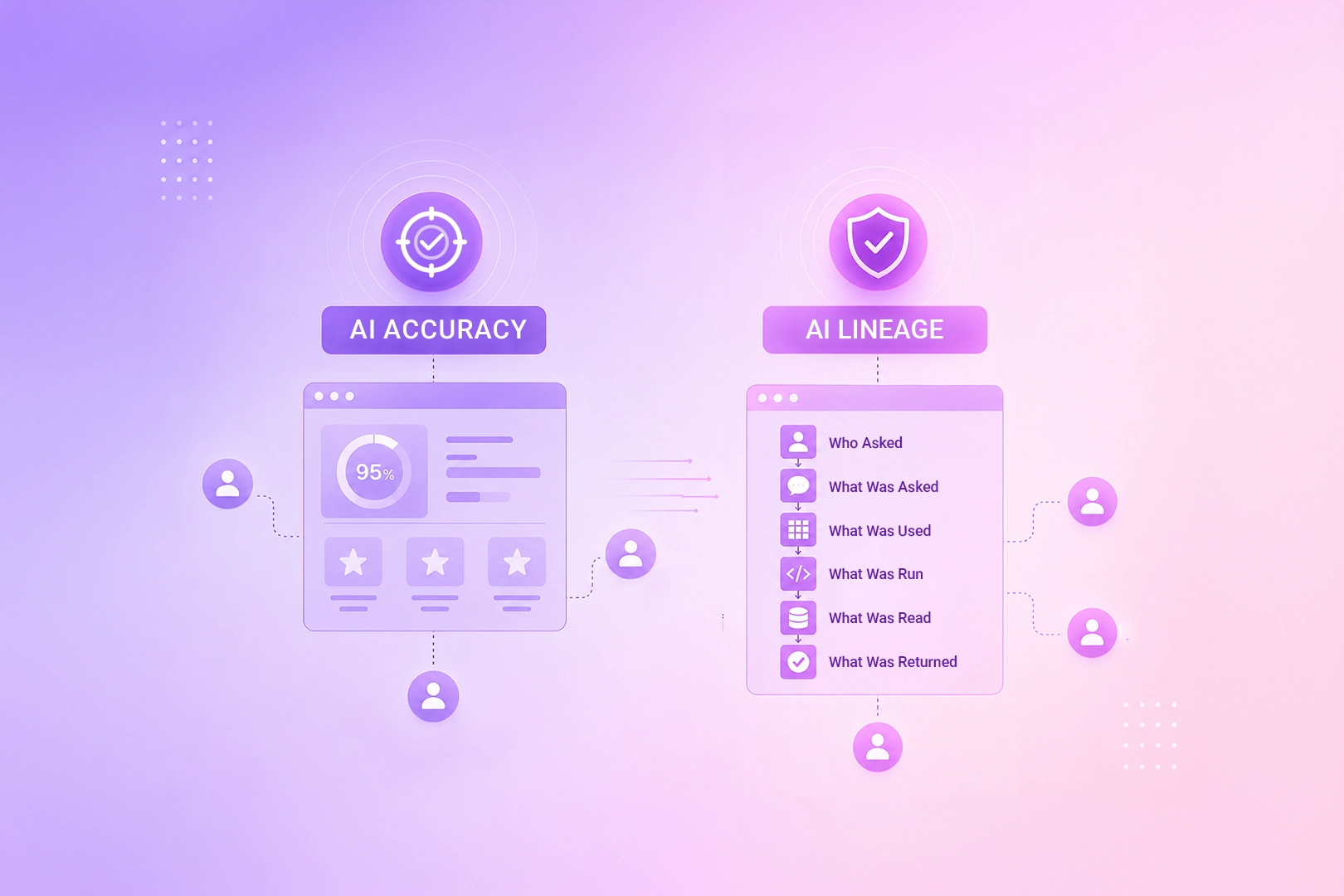
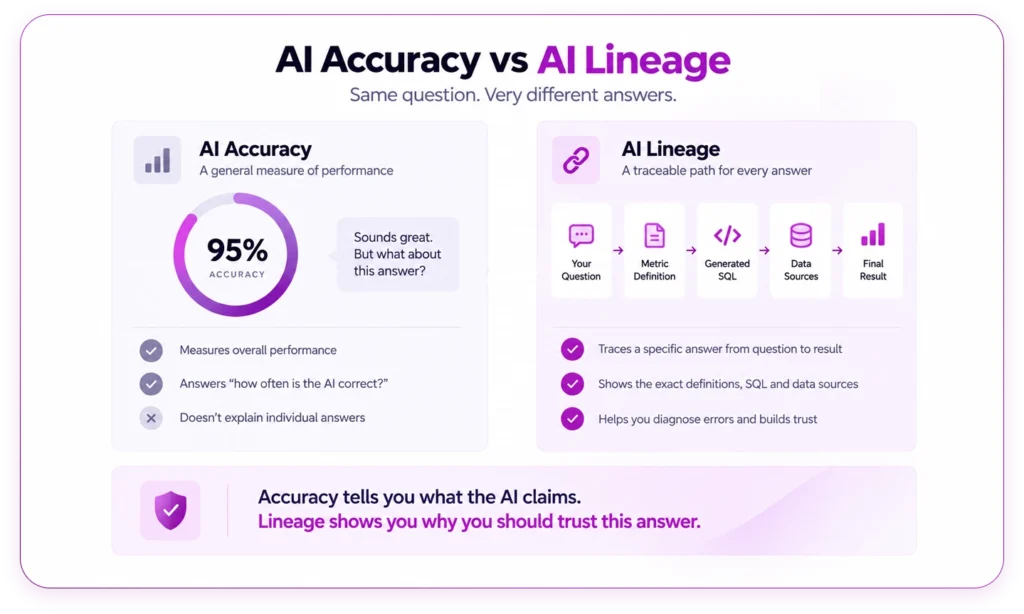
    Accuracy is the wrong first question about enterprise AI, and finance leaders are the first to figure this out. Not because accuracy is unimportant, but because accuracy is a claim, and CFOs are professionally trained to distrust claims they cannot verify. A vendor asserting 95 percent accuracy is telling the CFO nothing actionable. A vendor showing exactly how any individual answer was produced, from the question asked to the data read to the number returned, is telling the CFO something they can build a control around. The first is marketing. The second is lineage.

    Finance runs on traceability, not on averages

    Consider how a finance organisation already treats numbers. No controller accepts a figure into the close because the person who produced it is usually right. Every material number must tie back: to a ledger entry, to a reconciliation, to a documented source. The entire apparatus of financial control, from journal entry approval to SOX testing, is built on the principle that a number’s origin must be demonstrable, not merely trusted. Auditability is not a feature of financial reporting. It is the substance of it.

    An AI agent that produces analysis for finance is entering that apparatus, and the apparatus does not bend for new technology. When an agent’s output feeds a forecast, a close package, or a board deck, the CFO’s question is the same question finance asks of every number: show me where this came from. An aggregate accuracy statistic cannot answer it. The statistic says the system is right most of the time. The CFO needs to know whether it was right this time, and the only way to know is to trace this specific answer back through this specific chain.
    Accuracy without lineage is unverifiable, lineage makes accuracy testable

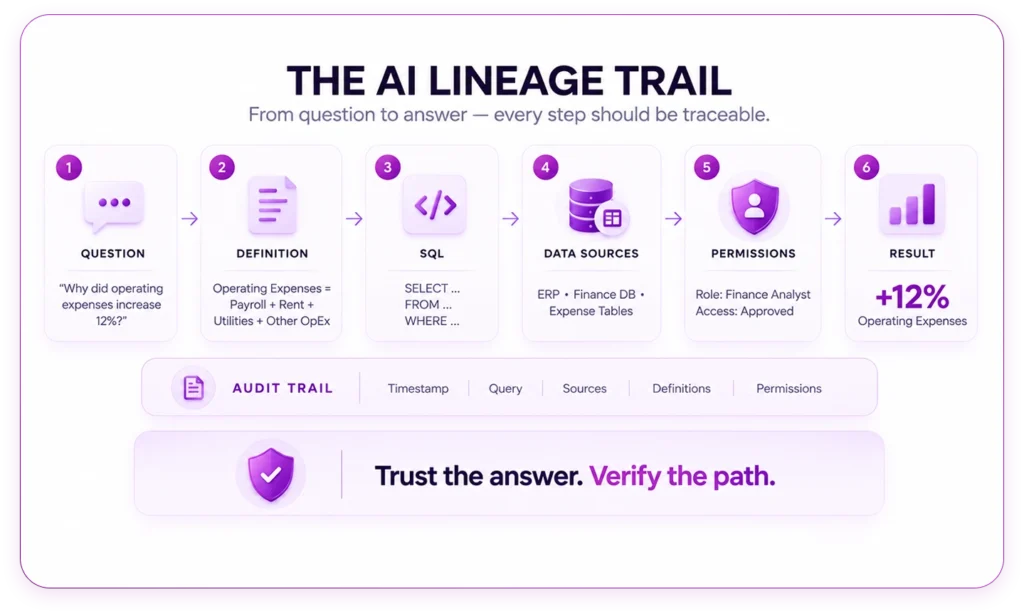
    Here is the asymmetry that puts lineage first. An accurate system with no lineage gives you correct answers you cannot prove are correct, which in a regulated finance context is nearly as unusable as wrong answers. A system with full lineage gives you something better than a promise: it gives you the means of verification. When every answer carries its question, its resolved metric definitions, its generated SQL, and its source tables, then accuracy stops being a vendor claim and becomes a property your own team can test, continuously, on your own data.

    Lineage is also what makes errors survivable. Every analytical system, human or machine, produces occasional wrong answers. In a lineage-complete system, a wrong answer is diagnosable: the reviewer finds the step where the chain went wrong, whether a misresolved definition or a flawed join, and the fix improves every subsequent answer. In a lineage-free system, a wrong answer is just a mystery that erodes trust, and there is nothing to fix because there is nothing to inspect. CFOs understand this instinctively, because it is exactly why finance documents its own work.

    The CFO is answerable for the number, so the CFO sets the bar

    There is a structural reason this question lands on the CFO’s desk with particular weight. When a figure reaches investors, the board, or a regulator, the CFO is personally accountable for it. Certification regimes in financial reporting attach executive names to reported numbers. An executive who signs numbers does not get to say the AI produced them. So before any AI-assisted analysis gets near external reporting, the CFO will require the same evidentiary standard applied to everything else in the reporting chain: complete, reviewable, retained documentation of origin. That standard has a name in this context, and it is lineage.

    The practical consequence for anyone selecting an analytics platform is that the finance organisation’s requirements will arrive whether or not they were in the original evaluation. Teams that select on demo quality and accuracy claims alone often discover the lineage requirement at the worst moment, when a number is already in circulation and someone senior asks for its provenance. Teams that select for lineage from the start never have that meeting.

    What to be able to show when the question comes

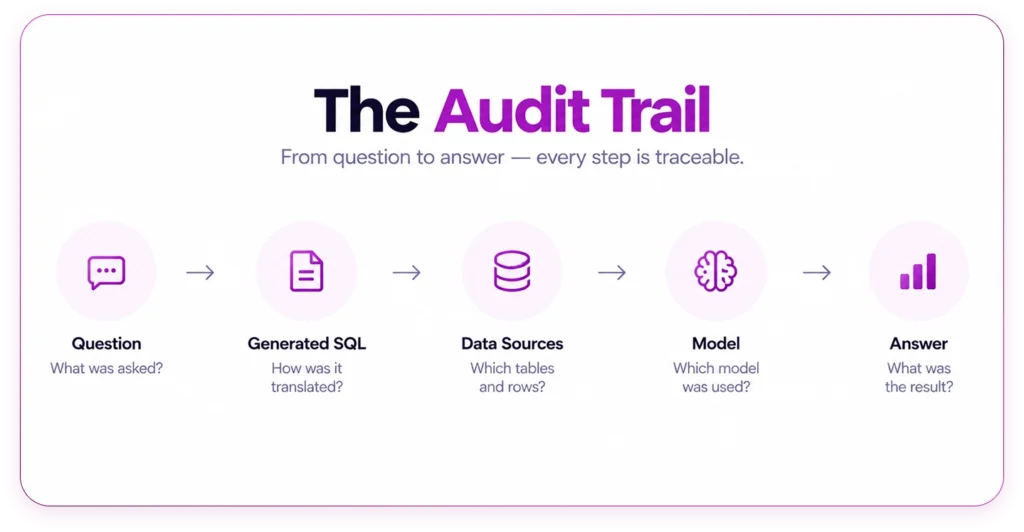
    The test is concrete. Take any single answer the platform has produced and demonstrate, from stored records rather than reconstruction, five things: who asked the question and under what permissions, the exact question asked, the certified definitions the question resolved against, the SQL executed and the tables it read, and the result returned. A platform built for governed agentic analytics produces this chain automatically on every query. Based on QuaerisAI customer deployments and published materials, this is the operating model behind results like a reduction from 170 hours to 70 hours on a standard audit engagement: when every answer arrives with its own evidence, the verification work that consumes senior hours collapses, because the proof was generated with the answer.
    Accuracy will always matter. But accuracy is what the system claims about itself, and lineage is what lets your CFO check. In finance, the checkable thing wins every time.

    Frequently asked questions

    What does AI lineage mean in analytics?

    AI lineage is the complete, recorded chain from a user’s question to the system’s answer: the identity and permissions of the asker, the question as phrased, the metric definitions it was resolved against, the query the system generated, the data sources that query read, the model that produced the reasoning, and the returned result. Data lineage traces where data came from. AI lineage extends the trace through the reasoning and generation steps as well.

    Is high accuracy enough for AI in financial reporting workflows?

    No. Financial reporting standards require that material numbers be supportable with documentation, not merely correct. An accurate answer with no reconstructible origin fails that test, because there is no evidence to review. In practice, lineage is the entry requirement and accuracy is what lineage lets you continuously verify.

    How should a finance team evaluate lineage in a vendor demo?

    Ask the vendor to pull the full record for one specific past query, live, without preparation. The record should show the asker, the prompt, the resolved definitions, the generated SQL, the tables touched, and the result, as one linked chain retrieved from storage. If producing it requires stitching together separate logs or engineering effort, the platform does not have lineage. It has logs.
  • The four pillars of Governed Agentic Analytics: audit, semantic, agentic, BYOM

    The four pillars of Governed Agentic Analytics: audit, semantic, agentic, BYOM

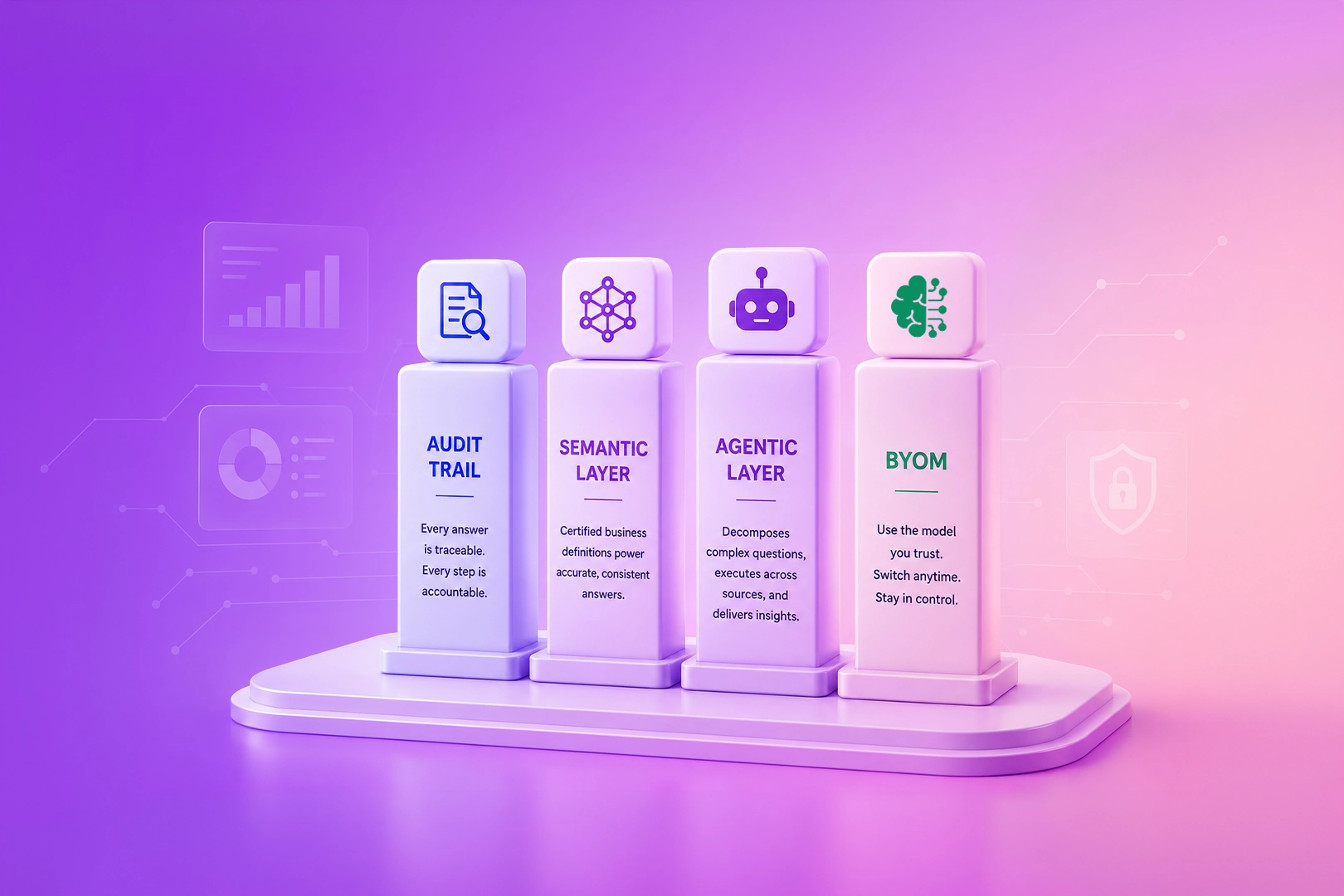
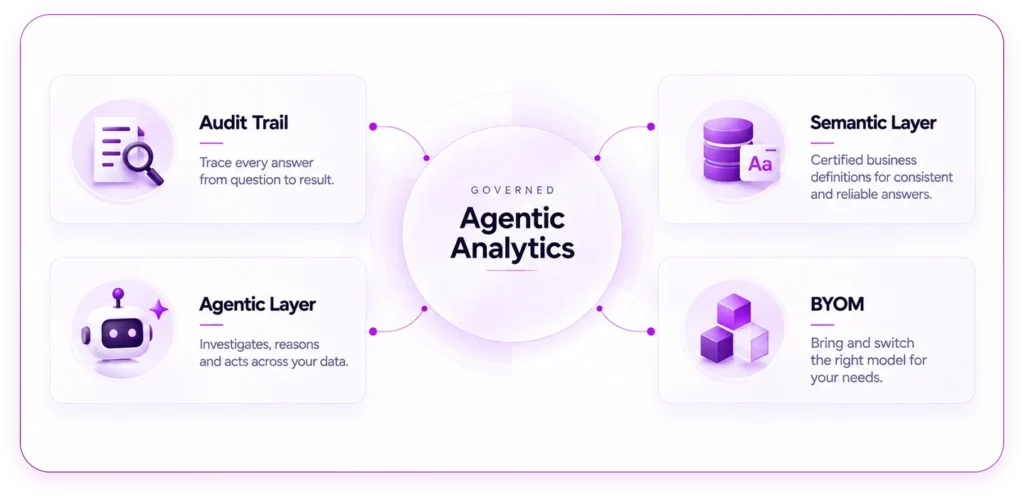
    Four capabilities separate a governed agentic platform from a chatbot bolted onto a warehouse. Remove any one of them and the structure fails in a specific, predictable way. This piece defines each pillar, explains what breaks without it, and shows how the four reinforce one another when they are built as one system rather than assembled from separate tools.

    Pillar one: the audit trail

    Every question asked of an agent should produce two artefacts: the answer, and the record of how the answer was produced. The audit pillar means logging the full chain on every interaction: who asked, what they asked, which SQL the agent generated, which tables and rows it touched, which model produced the reasoning, and what came back. This is the prompt-level audit trail, and it is the difference between an answer you can act on and an answer you can defend.

    Without it, every agent response is an orphan. When a number in a board deck is challenged three months later, there is no way to reconstruct where it came from. Internal audit cannot test the system. Regulators in banking, insurance, and healthcare cannot accept its outputs as evidence. The absence of an audit trail does not make an agent less useful day to day. It makes the agent indefensible on exactly the day it matters most.

    Pillar two: the semantic layer

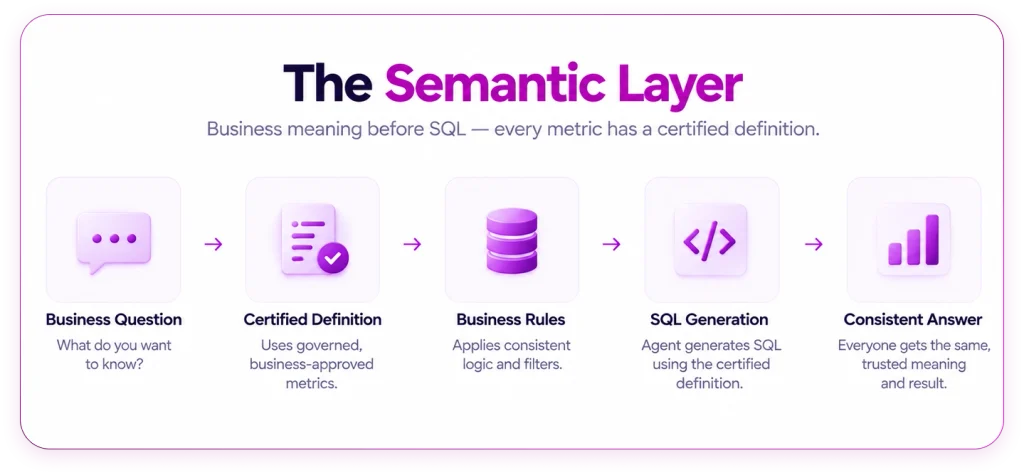
    An agent is only as accurate as its understanding of what the business means by its own words. The semantic pillar supplies that understanding: certified definitions of metrics, dimensions, and business terms that the agent consults before it writes a line of SQL. When someone asks about net revenue, the agent does not guess which of the fourteen revenue-adjacent columns in the warehouse to use. It uses the one the business certified.

    QuaerisAI’s Smart Semantic Layer adds a property that distinguishes it from manually authored alternatives: it learns. When an analyst corrects a definition or refines a query, the correction feeds back into the layer, so the next person asking a similar question benefits from it. Without a semantic layer of some kind, an agent hallucinates business logic, and it does so fluently, which is worse than failing loudly. Confidently wrong answers are the fastest way to destroy trust in an analytics deployment.

    Pillar three: the agentic layer

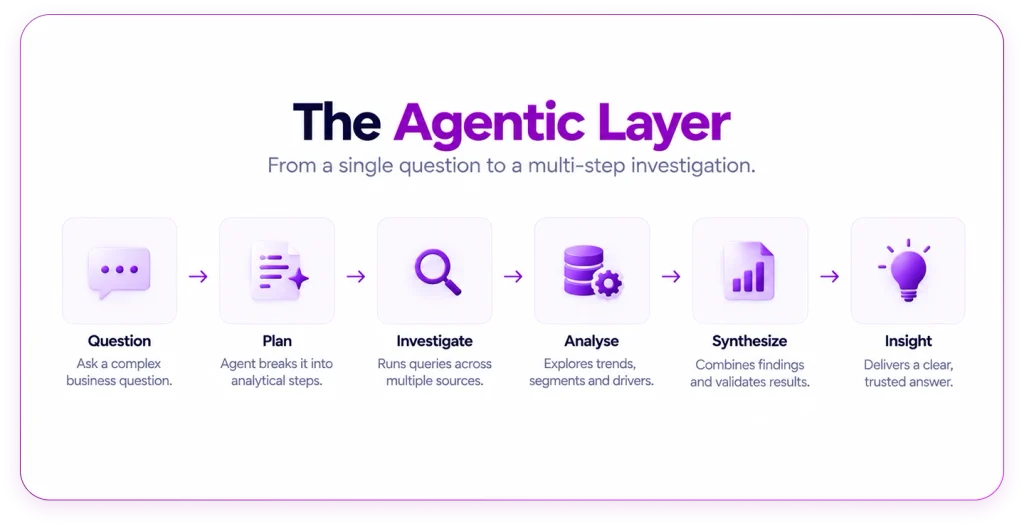
    The agentic pillar is what makes the platform more than search. Real analytical questions are rarely answered by one query. Why did margin dip in the northeast last quarter is a plan: pull the margin trend, decompose it by product line, check input costs, compare against the same period last year, and assemble a finding. The agentic layer is the capability to decompose a question into steps, execute them across structured and unstructured sources, and synthesise a result, autonomously.

    Without it, the platform is a text-to-SQL translator: useful for single-shot lookups, incapable of investigation. The user gets a number when they needed an explanation. The distinction matters commercially because the investigation work is where the senior-staff hours actually go. Based on QuaerisAI customer deployments and published materials, agentic deployment in audit engagements has reduced standard engagement time from 170 hours to 70 hours, a 59 percent reduction, precisely because the multi-step work is where the time was.

    Pillar four: BYOM

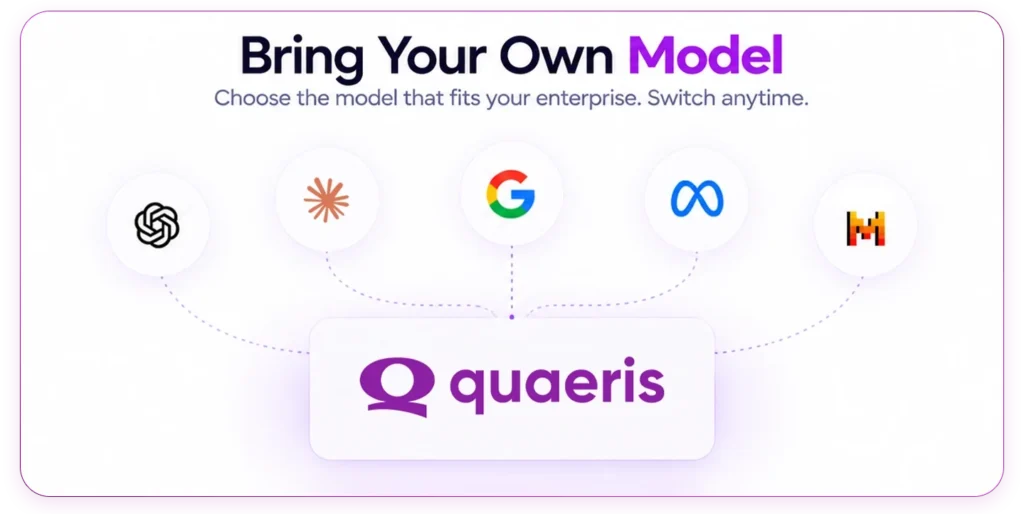
    Bring your own model means the platform runs on the language model the enterprise chooses, whether from Anthropic, OpenAI, Google, or Meta, rather than binding the customer to a single vendor’s model. This pillar looks like a procurement detail until the first time it is tested. A compliance team mandates a specific model for data-residency reasons. A model vendor changes pricing. A new model release outperforms the incumbent on SQL generation. In a BYOM architecture, each of these is a configuration decision. In a locked architecture, each is a re-platforming project.

    BYOM also changes the negotiating position. An enterprise that can switch models holds pricing power an enterprise that cannot switch has surrendered. And for regulated buyers, model choice is increasingly a compliance requirement in its own right, because model provenance is becoming part of what auditors and regulators expect organisations to document.

    Why the pillars only work together

    The four pillars are not a feature list. They are load-bearing in combination. The audit trail is only meaningful if the semantic layer makes answers deterministic enough to be worth auditing. The semantic layer only pays for itself when an agentic layer is asking it thousands of questions a day. The agentic layer is only deployable in the enterprise because the audit trail makes its autonomy accountable. And BYOM keeps the whole structure durable as the model market shifts underneath it.

    This is why assembling the equivalent from point solutions rarely works. A logging tool, a metrics store, an agent framework, and a model gateway from four vendors produce four integration seams, and governance fails at seams. Governed Agentic Analytics is one architecture, and the four pillars are its definition.

    Frequently asked questions

    Which pillar should an evaluation test first?

    The audit trail, because it is the hardest to retrofit and the easiest to verify in a demo. Ask the vendor to show the complete record for a single query: the prompt, the generated SQL, the tables touched, the model used, and the result. If that record does not exist or requires engineering effort to produce, the other three pillars are standing on sand.

    Is a semantic layer still necessary if the model is very capable?

    Yes. Model capability improves general reasoning, but no model can know that your finance team excludes intercompany transfers from net revenue, or that fiscal Q1 starts in February. Those are facts about your business, not facts about the world, and they have to be supplied by a governed definition layer. Stronger models make the semantic layer more valuable, not less, because they execute certified definitions more reliably.

    Does BYOM mean the customer manages model infrastructure?

    No. BYOM in the QuaerisAI architecture means the customer selects which model powers the platform, from providers including Anthropic, OpenAI, Google, and Meta, and can change that selection. The platform handles the integration. The customer holds the choice.

  • Stop moving data start moving decisions

    Stop moving data start moving decisions

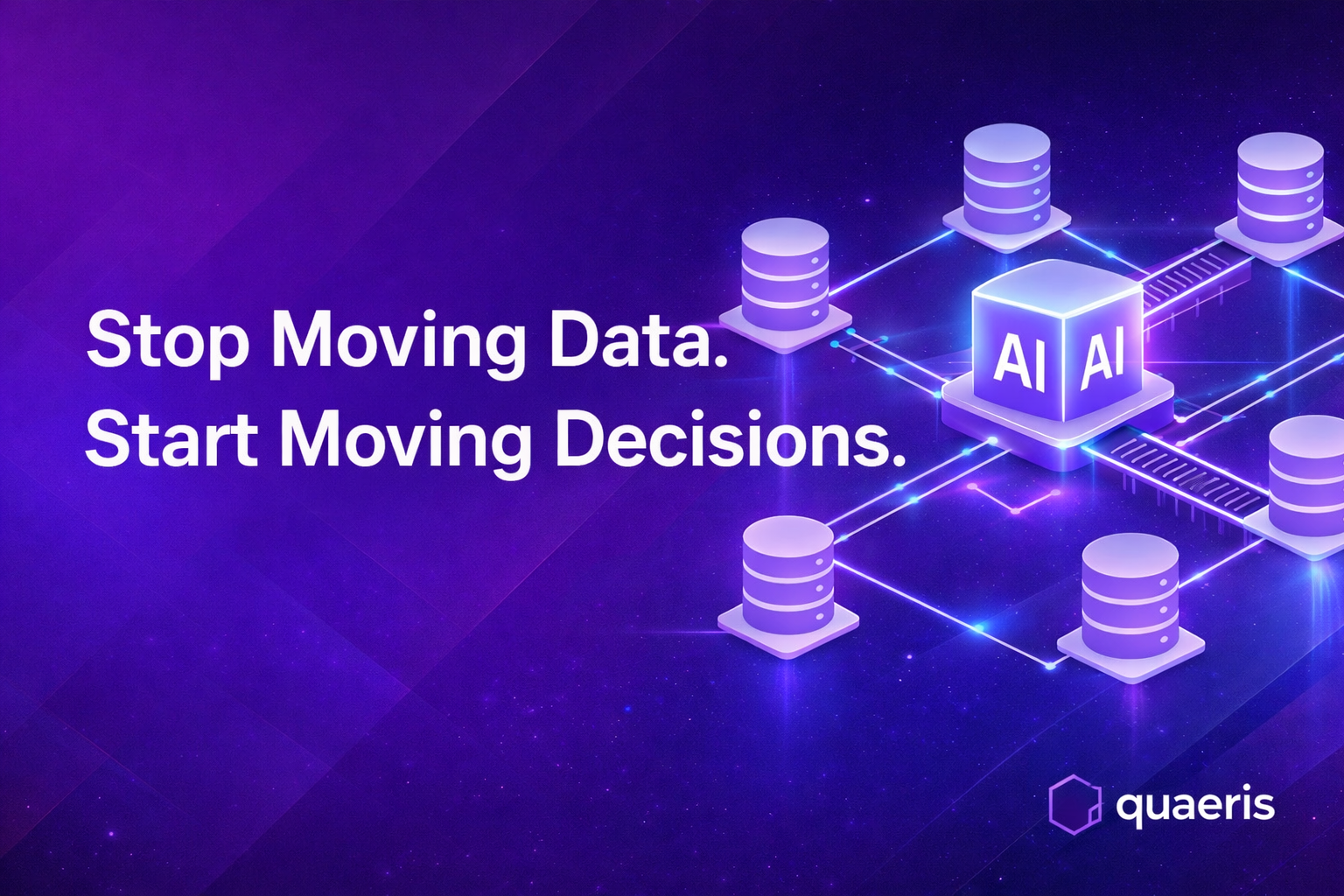
    Enterprise AI projects do not fail because the models are weak. They fail because answers arrive too late. Inside modern enterprises, data already exists. Questions already exist. Yet decisions still stall. The delay lives in the space between systems, teams, and trust, and for years the default response has been to move data closer to AI. Extract it. Transform it. Copy it. Store it again.

    That approach made sense at an earlier moment in the data stack’s evolution. It does not scale now, and the organisations still running it are paying a cost that rarely appears on any infrastructure budget.

    Why Most AI Initiatives Slow Teams Down

    On paper, the traditional model looks responsible. Data is cleaned, schemas are aligned, pipelines enforce order, and AI works on prepared datasets in controlled environments. In practice, the cost shows up somewhere else entirely.

    Pipelines take months to build. Data copies multiply. Latency compounds at each handoff. Engineering becomes the gatekeeper to every new question, and business users learn to stop asking. Over time this changes behaviour in ways that are difficult to reverse. Analysts drown in repeat requests. Leaders default to instinct because the system cannot move fast enough to be useful. The problem is not intelligence. It is timing.

    The Hidden Cost of Bringing Data to AI

    When organisations move data to AI, they also move responsibility. Every pipeline needs maintenance. Every copy introduces risk. Every transformation creates a chance for drift. Storage costs rise quietly. Governance becomes harder because truth exists in more than one place, and proving which version is authoritative becomes its own project.

    The real expense is not infrastructure. It is attention. Engineers spend their time keeping systems alive instead of improving how decisions get made. Analysts become translators instead of thinkers. Business teams wait for answers that are already stale by the time they arrive. Speed disappears without anyone noticing when it left.

    What Changes When AI Goes to the Data

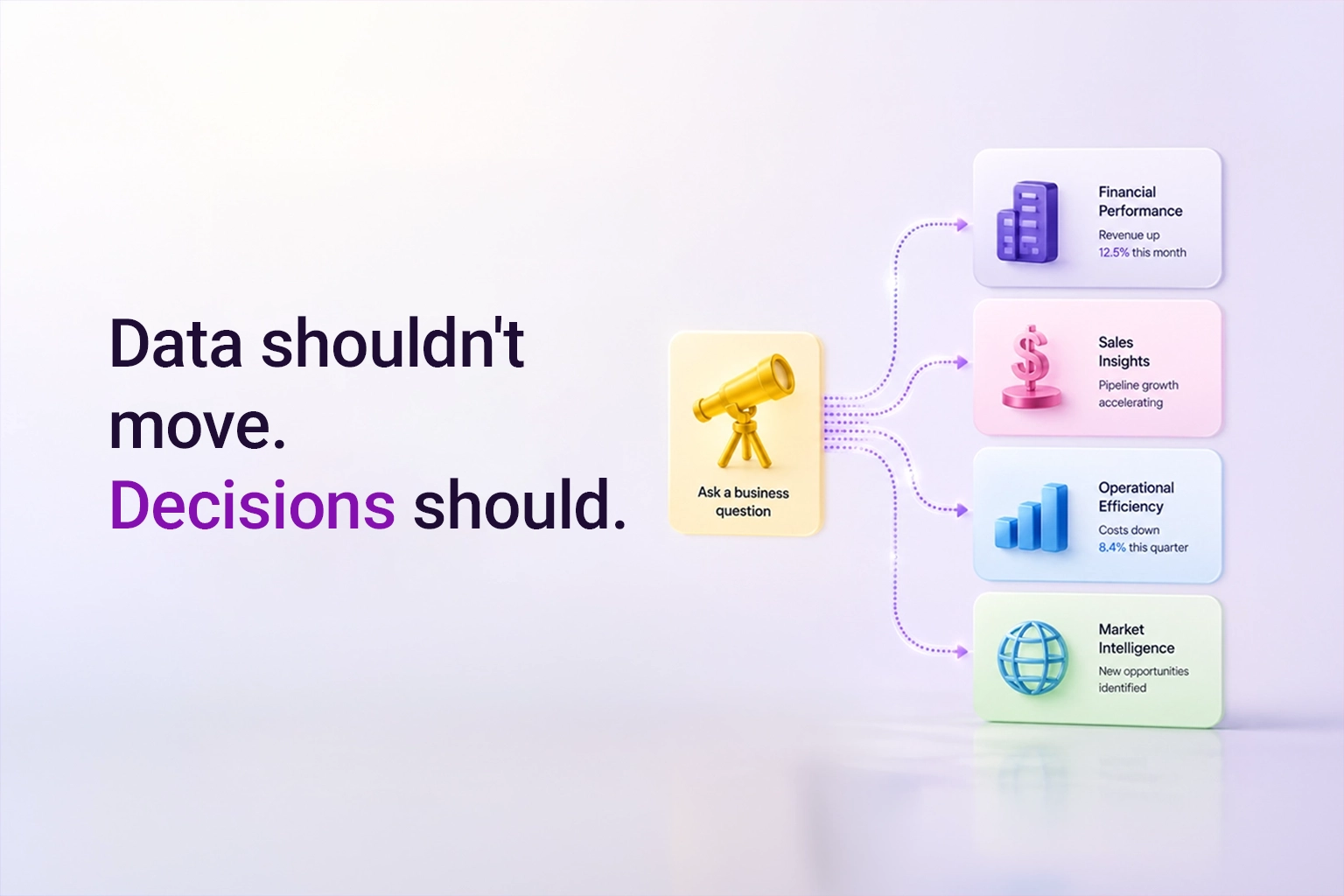
    When AI connects directly to the systems where data already lives, the shape of work changes fundamentally. There is no extraction step. There is no shadow warehouse built to serve a single query surface. AI operates as a service layer that reads, reasons, and responds in place, and the effects are immediate: answers reflect current reality, storage duplication drops, latency shrinks, and the number of questions teams feel comfortable asking goes up rather than down.

    Instead of preparing data for every possible question in advance, teams answer the questions that matter right now. AI becomes an access layer, not another destination. This is not about replacing the tools already in use. It is about activating them.

    Governance Improves When Nothing Moves

    The common concern about direct AI access is that it creates risk. In practice, copying data is what expands the risk surface. When AI queries systems in place, governance stays anchored to the source. Permissions remain intact. Audit trails are simpler. Compliance becomes clearer because there is one version of truth, and it has never moved.

    This matters especially in regulated environments where explainability is not optional. Answers are not just faster. They are traceable. Trust becomes a property of the system rather than a promise made after the fact, which is the only kind of trust that holds up under scrutiny.

    B4EA900D-9469-4113-BE27-72BEC1F843CD

    Decision Speed Is the Real Metric

    Analytics teams have historically measured success in outputs: dashboards delivered, models trained, pipelines deployed. The business measures something different. It measures whether the decision arrived in time.

    When AI meets data where it lives, speed changes behaviour across the organisation. Leaders ask follow-up questions instead of postponing meetings. Managers align teams faster because the numbers are not in dispute. Analysts spend more time on edge cases and less time rebuilding the same views for different stakeholders. Velocity returns, not because people work harder, but because the system stops getting in the way.

    From Pipelines to Presence

    The old model follows a familiar rhythm: build the pipeline, prepare the data, wait for results. The new model is structurally simpler: connect the systems, ask the question, act on the answer.

    The shift is subtle but the compounding effect is significant. AI becomes present at the moment of need rather than bolted on afterward. It supports how decisions are actually made inside the organisation, not how architecture diagrams say they should be made. The gap between knowing and doing narrows, and that gap is where most enterprise momentum is currently being lost.

    What This Means for Analytics Teams

    This change is not about removing analysts. It is about restoring their leverage. When AI handles access and translation, analysts become the owners of semantic definitions and the stewards of data trust. They define what metrics mean. They guide interpretation. They protect quality without becoming a bottleneck to every downstream request.

    The day-to-day work gets quieter. The strategic impact gets larger. Instead of managing a backlog, the team manages momentum, which is a fundamentally different and more valuable use of the skills that qualified analysts actually have.

    What This Means for Leaders

    For executives, the question is no longer which model is more capable. It is which model respects time. Every delayed answer carries a cost that compounds: missed windows, extra meetings, risk aversion, rework. Over time, hesitation becomes the organisational default, and reversing it requires more than a new tool.

    Bringing AI to data shortens the distance between knowing and doing. It gives organisations the ability to move with confidence rather than caution, which is the condition required for decisions to actually land.

    A Calmer Way Forward

    The future of enterprise AI is not louder models or more dashboards. It is calmer systems. Systems that do not demand constant rebuilding. Systems that meet people where they already work. Systems that answer questions while there is still time to act on them.

    When AI goes to the data, clarity arrives sooner. When clarity arrives sooner, decisions move. When decisions move, organisations recover the rhythm that slower systems took from them. That is the real advantage: not more intelligence, but less hesitation.