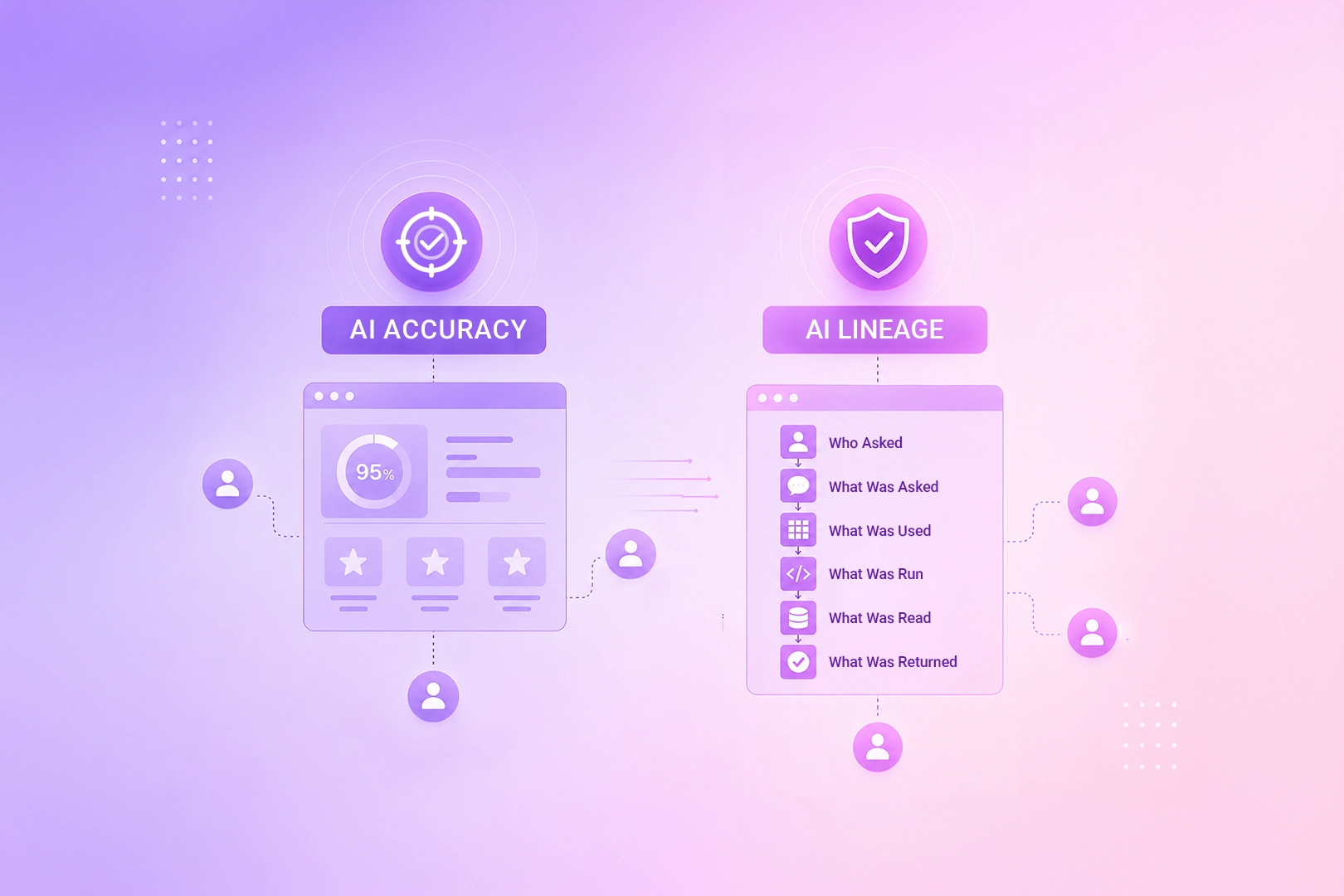
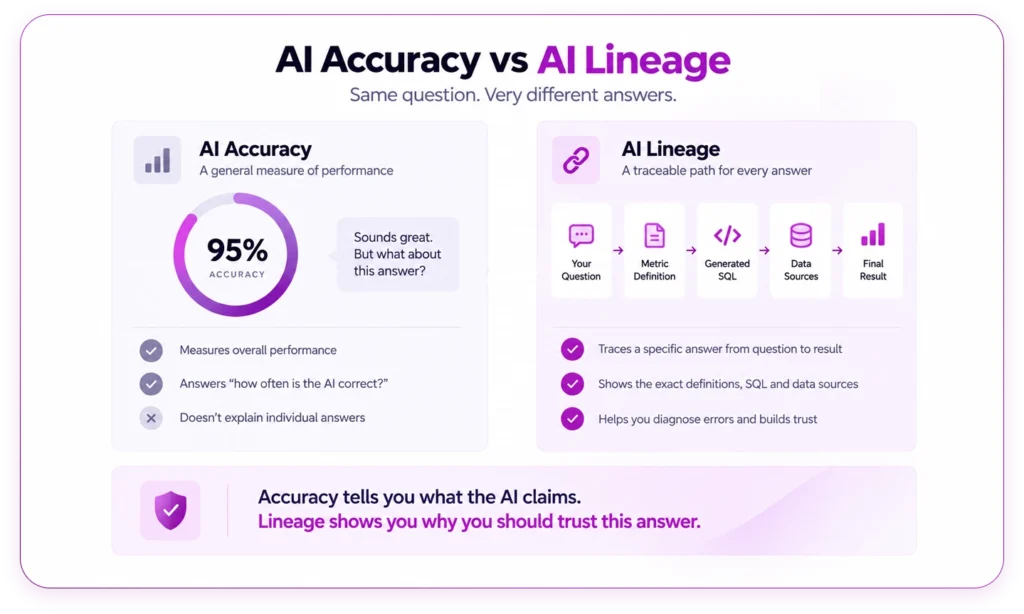
Accuracy is the wrong first question about enterprise AI, and finance leaders are the first to figure this out. Not because accuracy is unimportant, but because accuracy is a claim, and CFOs are professionally trained to distrust claims they cannot verify. A vendor asserting 95 percent accuracy is telling the CFO nothing actionable. A vendor showing exactly how any individual answer was produced, from the question asked to the data read to the number returned, is telling the CFO something they can build a control around. The first is marketing. The second is lineage.
Finance runs on traceability, not on averages
Consider how a finance organisation already treats numbers. No controller accepts a figure into the close because the person who produced it is usually right. Every material number must tie back: to a ledger entry, to a reconciliation, to a documented source. The entire apparatus of financial control, from journal entry approval to SOX testing, is built on the principle that a number’s origin must be demonstrable, not merely trusted. Auditability is not a feature of financial reporting. It is the substance of it.
An AI agent that produces analysis for finance is entering that apparatus, and the apparatus does not bend for new technology. When an agent’s output feeds a forecast, a close package, or a board deck, the CFO’s question is the same question finance asks of every number: show me where this came from. An aggregate accuracy statistic cannot answer it. The statistic says the system is right most of the time. The CFO needs to know whether it was right this time, and the only way to know is to trace this specific answer back through this specific chain.
Accuracy without lineage is unverifiable, lineage makes accuracy testable
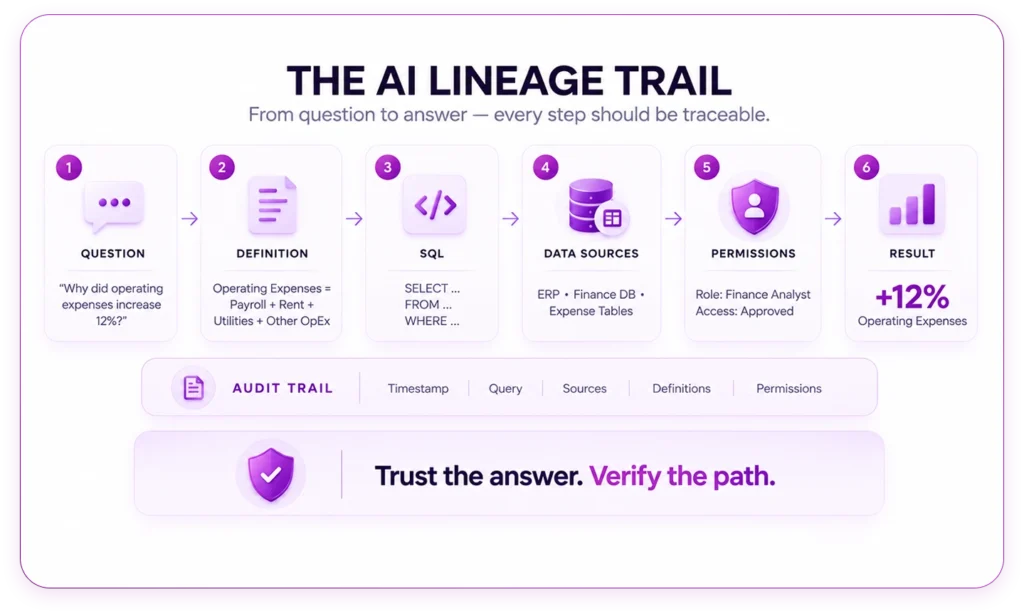
Here is the asymmetry that puts lineage first. An accurate system with no lineage gives you correct answers you cannot prove are correct, which in a regulated finance context is nearly as unusable as wrong answers. A system with full lineage gives you something better than a promise: it gives you the means of verification. When every answer carries its question, its resolved metric definitions, its generated SQL, and its source tables, then accuracy stops being a vendor claim and becomes a property your own team can test, continuously, on your own data.
Lineage is also what makes errors survivable. Every analytical system, human or machine, produces occasional wrong answers. In a lineage-complete system, a wrong answer is diagnosable: the reviewer finds the step where the chain went wrong, whether a misresolved definition or a flawed join, and the fix improves every subsequent answer. In a lineage-free system, a wrong answer is just a mystery that erodes trust, and there is nothing to fix because there is nothing to inspect. CFOs understand this instinctively, because it is exactly why finance documents its own work.
The CFO is answerable for the number, so the CFO sets the bar
There is a structural reason this question lands on the CFO’s desk with particular weight. When a figure reaches investors, the board, or a regulator, the CFO is personally accountable for it. Certification regimes in financial reporting attach executive names to reported numbers. An executive who signs numbers does not get to say the AI produced them. So before any AI-assisted analysis gets near external reporting, the CFO will require the same evidentiary standard applied to everything else in the reporting chain: complete, reviewable, retained documentation of origin. That standard has a name in this context, and it is lineage.
The practical consequence for anyone selecting an analytics platform is that the finance organisation’s requirements will arrive whether or not they were in the original evaluation. Teams that select on demo quality and accuracy claims alone often discover the lineage requirement at the worst moment, when a number is already in circulation and someone senior asks for its provenance. Teams that select for lineage from the start never have that meeting.
What to be able to show when the question comes
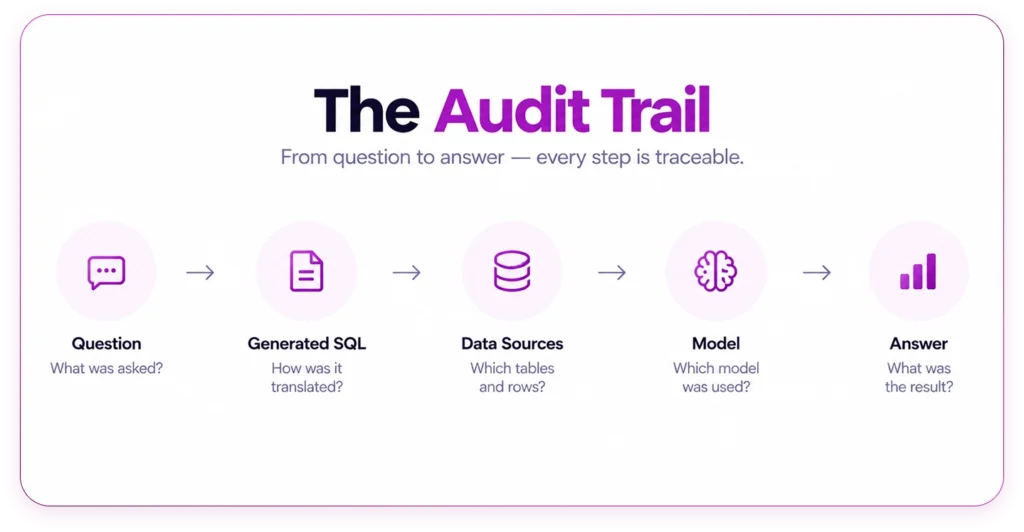
The test is concrete. Take any single answer the platform has produced and demonstrate, from stored records rather than reconstruction, five things: who asked the question and under what permissions, the exact question asked, the certified definitions the question resolved against, the SQL executed and the tables it read, and the result returned. A platform built for governed agentic analytics produces this chain automatically on every query. Based on QuaerisAI customer deployments and published materials, this is the operating model behind results like a reduction from 170 hours to 70 hours on a standard audit engagement: when every answer arrives with its own evidence, the verification work that consumes senior hours collapses, because the proof was generated with the answer.
Accuracy will always matter. But accuracy is what the system claims about itself, and lineage is what lets your CFO check. In finance, the checkable thing wins every time.
Frequently asked questions
What does AI lineage mean in analytics?
AI lineage is the complete, recorded chain from a user’s question to the system’s answer: the identity and permissions of the asker, the question as phrased, the metric definitions it was resolved against, the query the system generated, the data sources that query read, the model that produced the reasoning, and the returned result. Data lineage traces where data came from. AI lineage extends the trace through the reasoning and generation steps as well.
Is high accuracy enough for AI in financial reporting workflows?
No. Financial reporting standards require that material numbers be supportable with documentation, not merely correct. An accurate answer with no reconstructible origin fails that test, because there is no evidence to review. In practice, lineage is the entry requirement and accuracy is what lineage lets you continuously verify.
How should a finance team evaluate lineage in a vendor demo?
Ask the vendor to pull the full record for one specific past query, live, without preparation. The record should show the asker, the prompt, the resolved definitions, the generated SQL, the tables touched, and the result, as one linked chain retrieved from storage. If producing it requires stitching together separate logs or engineering effort, the platform does not have lineage. It has logs.
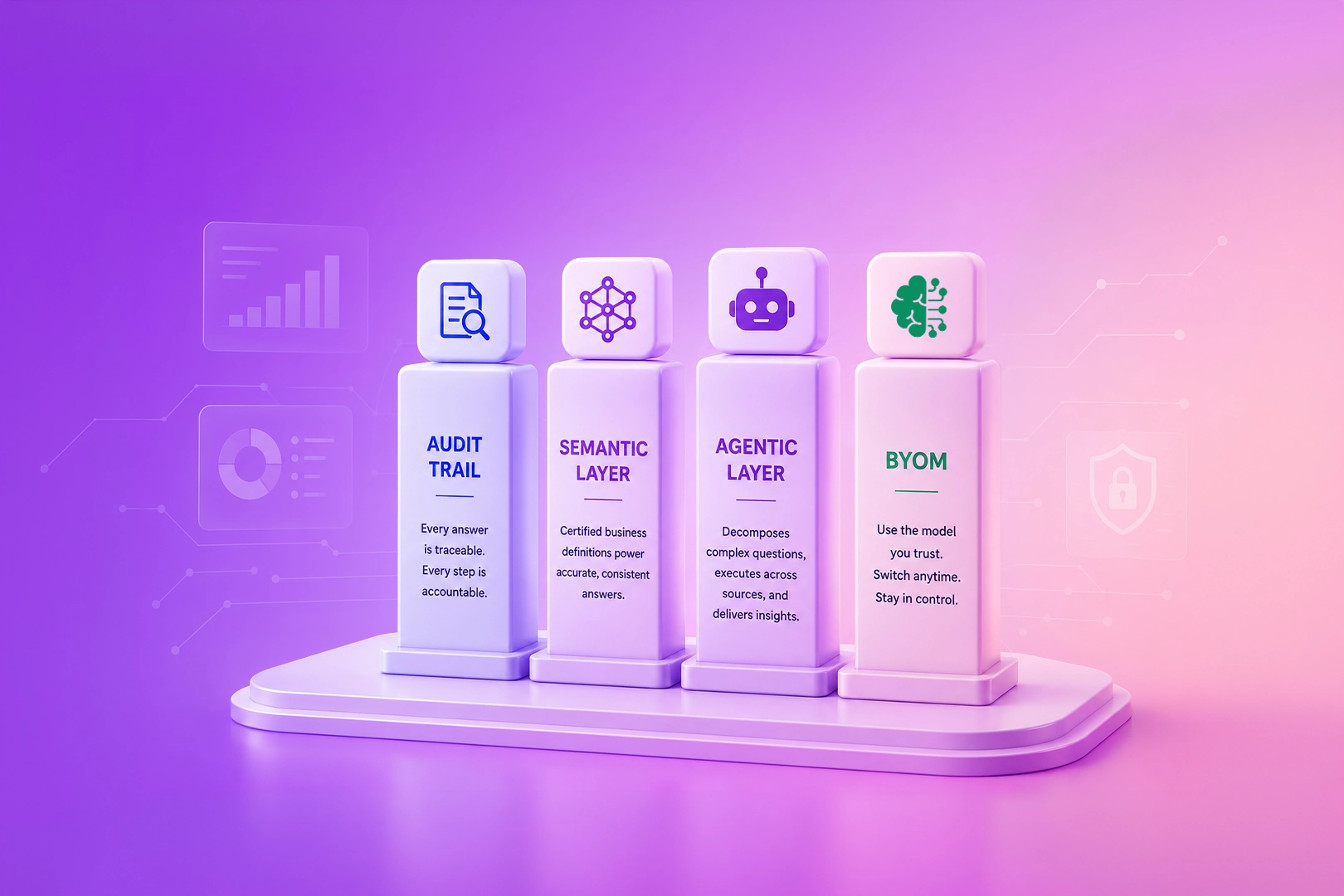
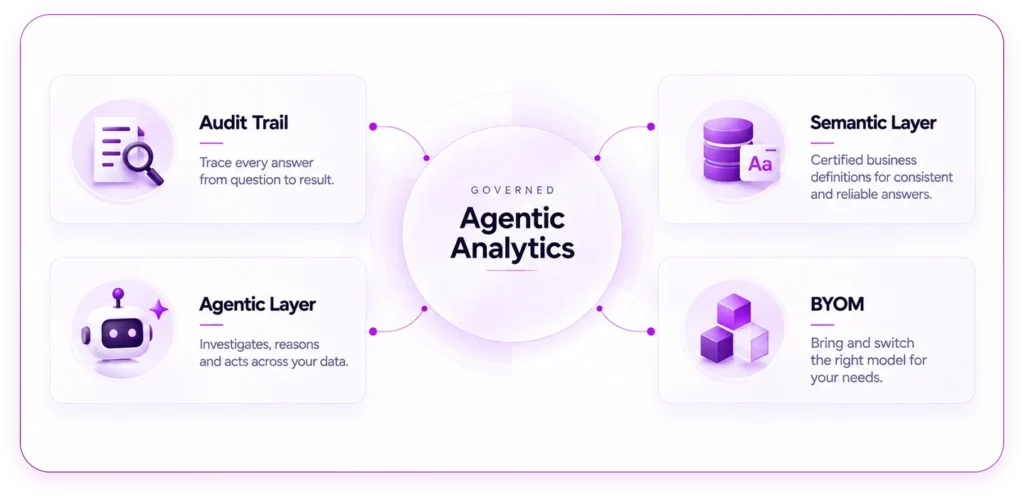
Four capabilities separate a governed agentic platform from a chatbot bolted onto a warehouse. Remove any one of them and the structure fails in a specific, predictable way. This piece defines each pillar, explains what breaks without it, and shows how the four reinforce one another when they are built as one system rather than assembled from separate tools.
Pillar one: the audit trail
Every question asked of an agent should produce two artefacts: the answer, and the record of how the answer was produced. The audit pillar means logging the full chain on every interaction: who asked, what they asked, which SQL the agent generated, which tables and rows it touched, which model produced the reasoning, and what came back. This is the prompt-level audit trail, and it is the difference between an answer you can act on and an answer you can defend.
Without it, every agent response is an orphan. When a number in a board deck is challenged three months later, there is no way to reconstruct where it came from. Internal audit cannot test the system. Regulators in banking, insurance, and healthcare cannot accept its outputs as evidence. The absence of an audit trail does not make an agent less useful day to day. It makes the agent indefensible on exactly the day it matters most.
Pillar two: the semantic layer
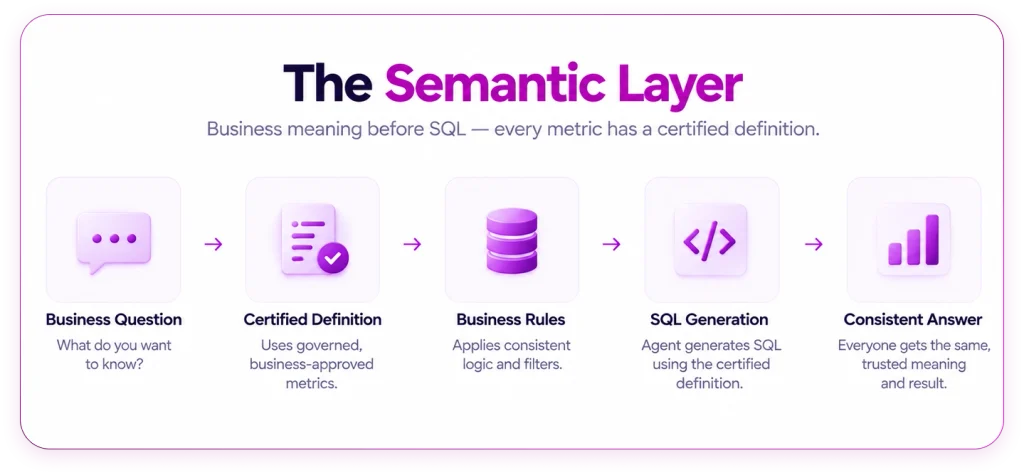
An agent is only as accurate as its understanding of what the business means by its own words. The semantic pillar supplies that understanding: certified definitions of metrics, dimensions, and business terms that the agent consults before it writes a line of SQL. When someone asks about net revenue, the agent does not guess which of the fourteen revenue-adjacent columns in the warehouse to use. It uses the one the business certified.
QuaerisAI’s Smart Semantic Layer adds a property that distinguishes it from manually authored alternatives: it learns. When an analyst corrects a definition or refines a query, the correction feeds back into the layer, so the next person asking a similar question benefits from it. Without a semantic layer of some kind, an agent hallucinates business logic, and it does so fluently, which is worse than failing loudly. Confidently wrong answers are the fastest way to destroy trust in an analytics deployment.
Pillar three: the agentic layer
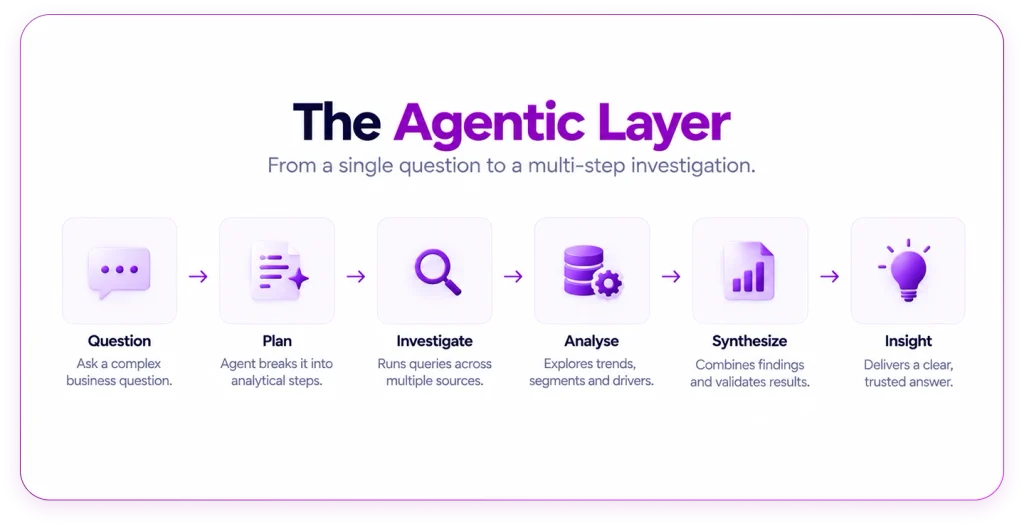
The agentic pillar is what makes the platform more than search. Real analytical questions are rarely answered by one query. Why did margin dip in the northeast last quarter is a plan: pull the margin trend, decompose it by product line, check input costs, compare against the same period last year, and assemble a finding. The agentic layer is the capability to decompose a question into steps, execute them across structured and unstructured sources, and synthesise a result, autonomously.
Without it, the platform is a text-to-SQL translator: useful for single-shot lookups, incapable of investigation. The user gets a number when they needed an explanation. The distinction matters commercially because the investigation work is where the senior-staff hours actually go. Based on QuaerisAI customer deployments and published materials, agentic deployment in audit engagements has reduced standard engagement time from 170 hours to 70 hours, a 59 percent reduction, precisely because the multi-step work is where the time was.
Pillar four: BYOM
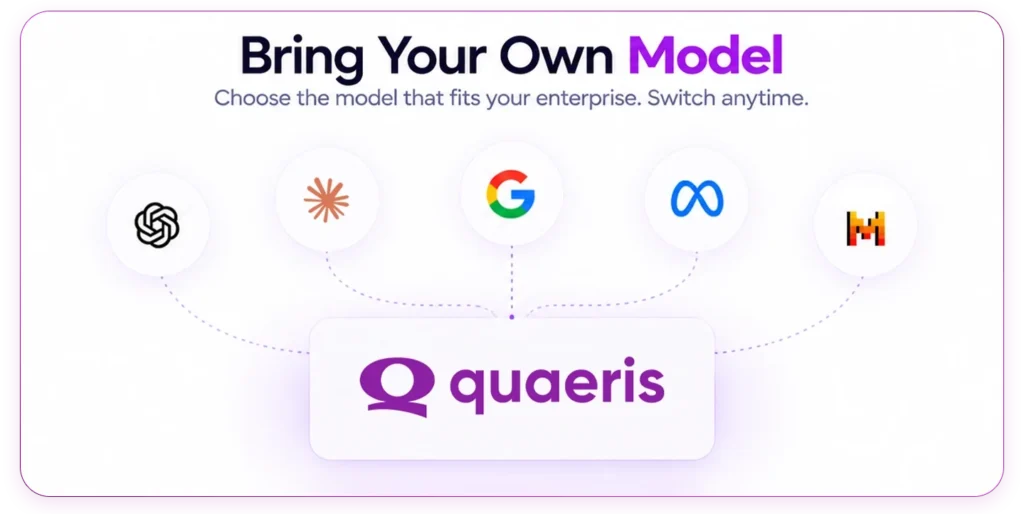
Bring your own model means the platform runs on the language model the enterprise chooses, whether from Anthropic, OpenAI, Google, or Meta, rather than binding the customer to a single vendor’s model. This pillar looks like a procurement detail until the first time it is tested. A compliance team mandates a specific model for data-residency reasons. A model vendor changes pricing. A new model release outperforms the incumbent on SQL generation. In a BYOM architecture, each of these is a configuration decision. In a locked architecture, each is a re-platforming project.
BYOM also changes the negotiating position. An enterprise that can switch models holds pricing power an enterprise that cannot switch has surrendered. And for regulated buyers, model choice is increasingly a compliance requirement in its own right, because model provenance is becoming part of what auditors and regulators expect organisations to document.
Why the pillars only work together
The four pillars are not a feature list. They are load-bearing in combination. The audit trail is only meaningful if the semantic layer makes answers deterministic enough to be worth auditing. The semantic layer only pays for itself when an agentic layer is asking it thousands of questions a day. The agentic layer is only deployable in the enterprise because the audit trail makes its autonomy accountable. And BYOM keeps the whole structure durable as the model market shifts underneath it.
This is why assembling the equivalent from point solutions rarely works. A logging tool, a metrics store, an agent framework, and a model gateway from four vendors produce four integration seams, and governance fails at seams. Governed Agentic Analytics is one architecture, and the four pillars are its definition.
Frequently asked questions
Which pillar should an evaluation test first?
The audit trail, because it is the hardest to retrofit and the easiest to verify in a demo. Ask the vendor to show the complete record for a single query: the prompt, the generated SQL, the tables touched, the model used, and the result. If that record does not exist or requires engineering effort to produce, the other three pillars are standing on sand.
Is a semantic layer still necessary if the model is very capable?
Yes. Model capability improves general reasoning, but no model can know that your finance team excludes intercompany transfers from net revenue, or that fiscal Q1 starts in February. Those are facts about your business, not facts about the world, and they have to be supplied by a governed definition layer. Stronger models make the semantic layer more valuable, not less, because they execute certified definitions more reliably.
Does BYOM mean the customer manages model infrastructure?
No. BYOM in the QuaerisAI architecture means the customer selects which model powers the platform, from providers including Anthropic, OpenAI, Google, and Meta, and can change that selection. The platform handles the integration. The customer holds the choice.
For the last two decades, getting an answer out of company data followed a predictable, frustrating script. A business user had a question. They filed a ticket. A data analyst built a query or a report. Days, sometimes weeks later, a dashboard appeared. By then the question had often changed, and the cycle started again. The bottleneck was never the data. It was the distance between a question and an answer.
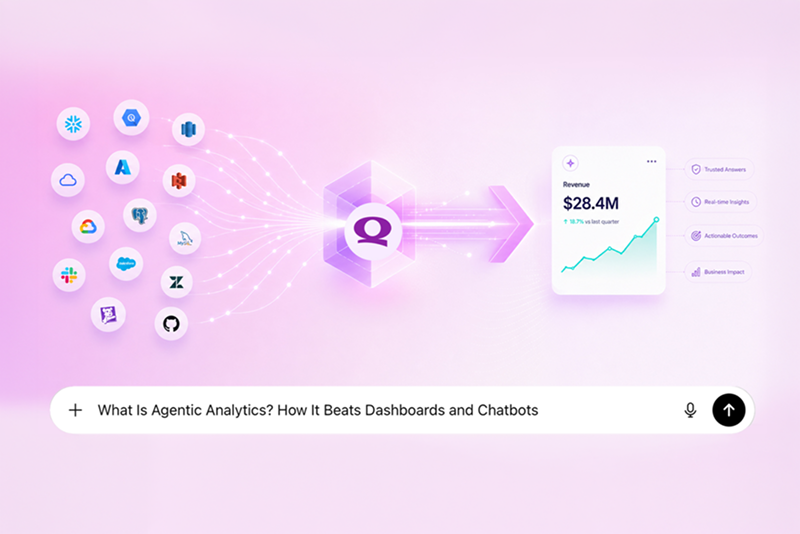
Agentic analytics is the most serious attempt yet to close that distance. Instead of asking people to drive every step, write the query, build the chart, read the result, decide what to do, it hands much of that work to autonomous AI agents that can investigate, reason, and act on their own. The term is still new, but the momentum behind it is not: nearly every major analytics vendor, from Tableau to Databricks, has launched or announced an agentic capability in the past year.
This article unpacks what that actually means and, just as importantly, what it does not. Because “agentic analytics” gets used interchangeably with “AI dashboards” and “data chatbots,” and those are three genuinely different things.
From Hindsight to Action: How Analytics Evolved Into Agentic Systems
To understand why agentic analytics matters, it helps to see the staircase it sits on top of. For years, analysts have described the field through a maturity progression, a model popularised by Gartner and taught in nearly every data course, that moves from looking backward to looking forward.
Descriptive analytics answers “What happened?” It summarises historical data into trends, totals, and KPIs. Diagnostic analytics answers “Why did it happen?” It digs beneath the surface to find root causes. Predictive analytics answers “What will happen?” It uses statistical models and machine learning to forecast future outcomes. Prescriptive analytics answers “How do we make it happen?” It recommends actions based on those predictions.
Each step moves an organisation further along the path from hindsight to foresight. But every single stage has one thing in common: a human being is still in the driver’s seat. A person decides what to query, builds the model, reads the chart, and chooses what to do next.
Why Dashboards Stalled at “What Happened”
Traditional business intelligence dashboards mastered the first two stages. They turned raw tables into clean visuals and let teams track performance at a glance. That was a genuine advance, but it came with a ceiling. Dashboards are fundamentally reactive. They present information and then wait. As one widely read CIO analysis of the shift away from dashboards notes, reports are retrospective: they describe what happened, but they do not tell you what to do next, and they certainly do not do it for you.
Large language models added a new layer: conversational interfaces and copilots that let people ask questions in their own words. That was a real improvement in access. But a chatbot still answers one prompt and stops. The human is still the engine moving the work forward.
Agentic analytics is the next stair. It pairs the ability to act independently toward a goal with analytics, and in doing so it finally removes the human from the centre of every loop.
What Agentic Analytics Actually Means
Here is the clearest definition: agentic analytics is a form of data analysis that uses intelligent AI agents to explore data, generate insights, and take context-aware actions with minimal human input.
The key word is “agent.” An AI agent is not just a model that answers a question. It is an autonomous system that can plan a multi-step task, execute each step, observe the results, and adapt its approach, all in service of a goal you have given it. As GoodData’s guide to agentic analytics describes it, the system reasons through complex data challenges and executes multi-step analyses without constant human intervention.
The Reasoning-and-Action Loop
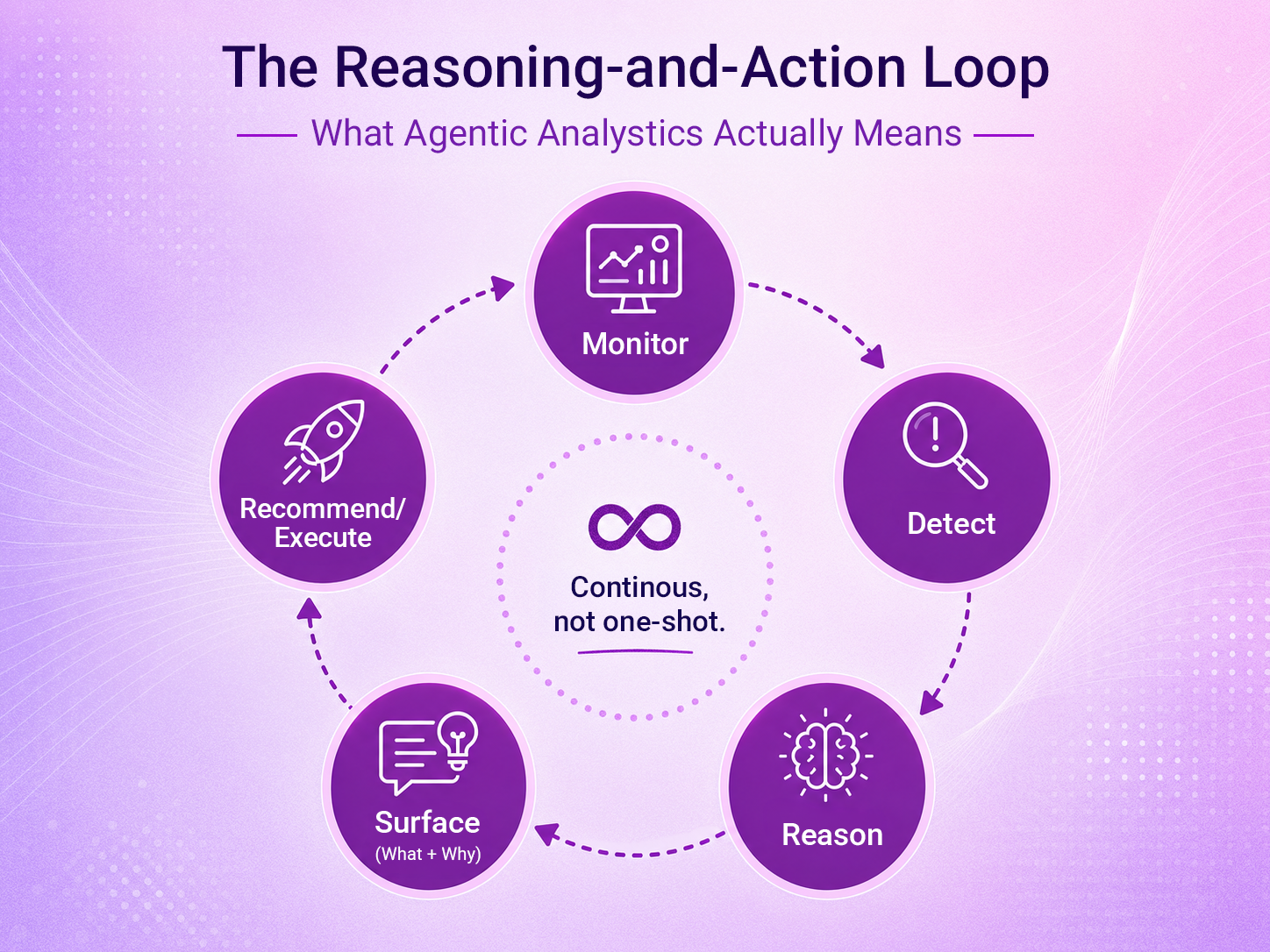
What separates an agent from a chatbot is the loop. Rather than a single request-and-response, an agentic system runs a continuous cycle: monitor incoming data streams, detect patterns or anomalies, reason about what those results mean, surface the insight explaining not just what but why, then recommend or execute the appropriate next action.
As Scoop Analytics notes in its breakdown of the category, agentic systems plan and execute multi-step investigations without a human driving each click. The agent might pull from a warehouse, join it against a document store, run a diagnostic query, notice an outlier, dig deeper, and only then report back, a sequence that would have taken an analyst hours of manual work.
This is what people mean when they say agentic analytics moves from data-about-the-past to action-in-the-present. As ThoughtSpot frames it, it is “AI that acts on your data,” not just AI that talks about it.
Agentic Analytics vs BI Dashboards vs Chatbots and Copilots
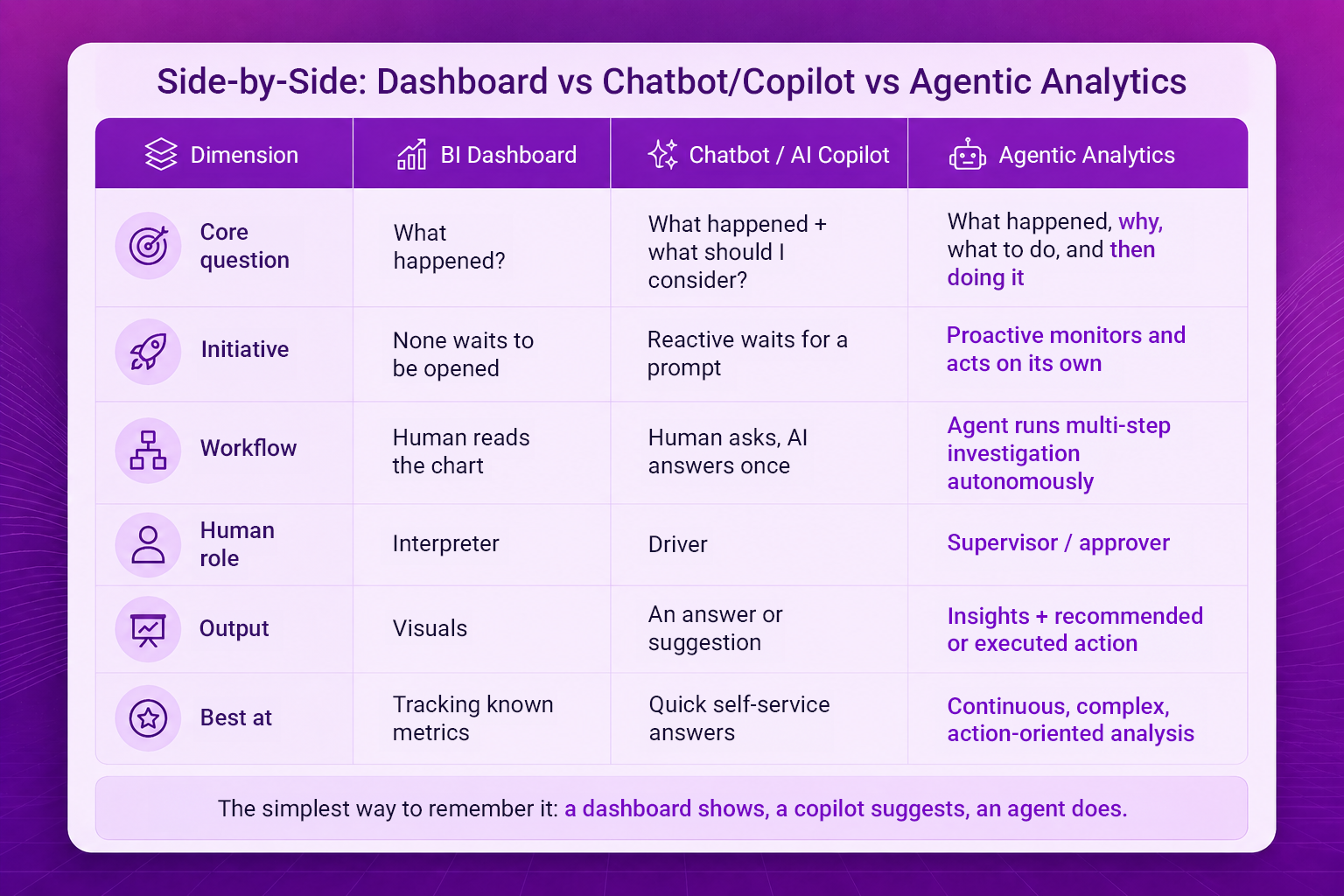
This is the distinction most articles blur, so it is worth slowing down. There are three different things here, and confusing them leads to poor decisions.
A BI dashboard is a visualisation layer over historical and current data. It is excellent at at-a-glance KPIs, trend lines, and drill-downs. But it has no initiative. It will show you that revenue dropped 12% last week and then sit there indefinitely. It waits for a human to notice, interpret, and act. Nothing happens unless someone opens it.
A data chatbot lets you ask a question and get an answer back. An AI copilot goes a step further, suggesting actions and recommending next steps. But as Microsoft explains in its comparison of agents and chatbots, the defining feature of a copilot is human control: it suggests, but it will not execute without approval, and it handles one prompt at a time.
An AI agent is built to plan, execute, and adapt multi-step tasks toward a defined goal. Unlike a chatbot that answers questions or a copilot that suggests actions, an agent takes independent action across multiple systems, calling APIs, querying databases, and adjusting its plan based on what it discovers. It does not wait to be told each step.
How Agentic Analytics Makes Everyday Work Easier
Strip away the hype and the value proposition is simple: agentic analytics collapses the distance between a question and an action.
For a business user, it means asking “why did churn spike in our enterprise segment?” and getting a sourced, explained answer in seconds, no ticket, no SQL, no waiting. For a data analyst, it means handing off repetitive report-building and first-pass investigation to an agent, and spending time on the judgment-heavy work that actually needs a human. For a leader, it means the organisation stops flying blind between weekly reviews. Problems get flagged, diagnosed, and where appropriate acted on continuously, and because every answer carries citations, data lineage, and an audit trail, the speed does not come at the cost of trust.
That last point is the whole game. The early lesson of this category is that speed without trust is worthless in the enterprise. The platforms that win will be the ones that deliver both.
How Agentic Analytics Works Under the Hood
Under the surface, an agentic analytics platform stitches together a few well-understood components into something new.
First, there’s the reasoning engine typically a large language model that interprets a goal, breaks it into steps, and decides what to do next. Second, there’s a set of tools the agent can call: SQL generators, the data warehouse, document stores, statistical functions, alerting systems, even other agents. Third, and most underrated, there’s a semantic layer that defines what the business actually means by terms like “revenue,” “active customer,” or “churn.”
That semantic layer is what keeps an agent honest. Without it, an agent might technically write correct SQL against the wrong definition of a metric and confidently hand you a wrong number. With a governed semantic layer, the agent’s autonomy is anchored to a single, agreed-upon source of truth which is exactly why the most credible enterprise platforms put governance at the center rather than treating it as an afterthought.
A typical agentic workflow looks like this: you give the agent a goal (“tell me why margins slipped in the Northeast region last quarter”). The agent plans an investigation, translates the request into governed queries, pulls the relevant data, notices that one product line drove most of the decline, cross-references it against a supplier-contract document, and returns a narrative answer with the underlying numbers, the citations, and a recommended action attached. As the platform learns your data and your definitions, it gets faster and more accurate over time.
Where is that showing up in practice? A few patterns stand out:
Continuous monitoring and anomaly detection agents watch revenue, usage, supply chains, or marketing performance around the clock and raise a flag (with a diagnosis) the moment something drifts, rather than waiting for a weekly review.
Self-service analytics for non-technical teams finance, operations, and sales staff ask questions in plain English and get governed answers without a ticket to the data team.
Root-cause investigations instead of a human chasing a metric across five dashboards, an agent runs the whole diagnostic chain and reports back with the “why.”
High-stakes, audit-heavy industries finance, insurance, healthcare, and manufacturing are adopting agentic analytics specifically because it can attach citations, lineage, and an audit trail to every answer, making the output defensible.
Natural language to governed SQL. Users ask questions in plain English, and Quaeris AI agents translate them into precise, governed SQL so the speed of conversation never sidesteps the rules that keep numbers correct.
Autonomous multi-step workflows. Rather than answering one question and stopping, the agents handle the entire analysis end to end, behaving like a dedicated analytics partner so teams can focus on the decision rather than the busywork.
Predictive and proactive monitoring. The agents forecast, flag anomalies, and diagnose root causes, sending proactive alerts so issues get resolved before they hit the business the proactive loop that defines true agentic analytics.
A self-learning semantic layer. Unlike traditional BI tools that need months of data modeling, Quaeris AI learns your business definitions and data relationships as you interact, keeping every team aligned on a single source of truth.
Bring Your Own Model (BYOM) and document agents. Teams can connect the model of their choice OpenAI, Anthropic, Google, or Meta and Quaeris AI’s data and document agents unify warehouse data with thousands of contracts, invoices, or resumes in a single query.
When it works, the upside is substantial and concrete.
Speed to answer. This is the headline. Business questions change faster than data teams can build reports, and agentic systems return answers in seconds rather than the days or weeks a traditional reporting cycle demands. The ticket-and-wait bottleneck largely disappears.
It’s proactive, not reactive. A dashboard waits to be opened; an agent continuously monitors data, surfaces anomalies, and alerts you before a small problem becomes a large one. This is the single biggest behavioral difference and, for many teams, the most valuable one.
It explains “why” and “what next.” Agentic analytics doesn’t stop at what happened. It moves into root-cause diagnosis and recommended action, compressing the descriptive-diagnostic-predictive-prescriptive staircase into one continuous motion.
It widens access. Natural-language interfaces mean non-technical users can query data without writing SQL or filing a ticket. That democratizes analytics and frees skilled analysts from being a human query service.
It enforces consistency at scale. Paired with a semantic layer, agents apply the same metric definitions everywhere, so two teams asking the same question get the same answer.
It handles the full workflow. Rather than answering one isolated question, an agent manages ingestion, preparation, querying, interpretation, and reporting as a single multi-step task the part that used to eat an analyst’s afternoon.
The Honest Limitations and Risks You Should Plan For
Agentic analytics is genuinely promising, but treating it as a finished, fully trustworthy technology would be a mistake. The autonomy that powers it is also its biggest liability, and responsible adopters plan for that.
Reliability and “action hallucinations.” Ordinary AI hallucinations involve stating a false fact. Agentic systems introduce a more dangerous variant: action hallucinations, where an agent reports that it did something it didn’t actually do for example, confirming a refund was processed when the transaction failed. Because agents work in multi-step chains, an error in step one can compound across every step that follows.
Governance and accountability gaps. Traditional AI governance leans on pre-deployment approval and static controls. As the Cloud Security Alliance explains in its analysis of agentic AI risks, that approach is fragile for agents, because they change behavior over time and act continuously which demands ongoing monitoring rather than a one-time sign-off. It also raises an unresolved question: when an autonomous agent takes a costly action, who is accountable the developer, the operator, or the system owner?
The trust and oversight burden. Autonomous action in messy enterprise environments requires continuous human oversight, not blind delegation. Some experts argue complete trust may never be fully warranted while the potential to hallucinate exists. The practical takeaway: keep a human in the loop for high-stakes actions, demand citations and audit trails, and start with bounded, low-risk use cases.
How Agentic Analytics Makes Everyday Work Easier
Strip away the hype and the value proposition is simple: agentic analytics collapses the distance between a question and an action.
For a business user, it means asking “why did churn spike in our enterprise segment?” in plain English and getting a sourced, explained answer in seconds no ticket, no SQL, no waiting.
For a data analyst, it means handing off the repetitive report-building and first-pass investigation to an agent, and spending their time on the judgment-heavy work that actually needs a human.
For a leader, it means the organization stops flying blind between weekly reviews. Problems get flagged, diagnosed, and (where appropriate) acted on continuously and because every answer can carry citations, data lineage, and an audit trail, the speed doesn’t come at the cost of trust.
That last point is the whole game. The early lesson of this category is that speed without trust is worthless in the enterprise. The platforms that win will be the ones that deliver both.
How Quaeris AI Is Adapting Agentic Analytics for Smarter Results
This is exactly the problem Quaeris AI was built to solve and it’s why the company’s approach to agentic analytics leads with a deliberate phrase: “Secure, Governed Analytics. Powered by Trusted Agents.”
Where much of the market treats autonomy and governance as a trade-off, Quaeris AI treats them as a single design requirement. Its trusted agents query enterprise data and deliver governed answers instantly with full citations, data lineage, and security built in, not bolted on. That directly answers the biggest objection to agentic analytics: that an autonomous agent might act fast but can’t be trusted or audited.
A few ways Quaeris AI is adapting the technology for real-world, high-stakes use:
Built for finance, insurance, healthcare, manufacturing, and other industries where audit trails are the standard, not the exception, Quaeris AI positions itself as a forward-thinking adopter of agentic analytics one betting that the future belongs to agents you can actually trust. You can explore the approach on the Quaeris AI platform overview, see how conversational queries work, or read more on the Quaeris AI blog.
The Bottom Line: Choosing Speed and Trust Together
Agentic analytics represents a real shift from analytics you have to operate to analytics that operates itself. It sits at the top of the long staircase that runs from descriptive reporting to prescriptive recommendations, and it’s the first stage that finally takes the human out of the center of every loop. The payoff is speed, proactivity, and access; the catch is that autonomy without governance is a liability, not a feature.
The organizations that win with agentic analytics won’t be the ones that move fastest. They’ll be the ones that move fast and keep their answers trustworthy with citations, lineage, audit trails, and a human supervising the decisions that matter. If you can get both, you don’t just get faster reports. You get a business that closes the gap between a question and the right action, every single day.
Want to see governed, agentic analytics in action? Explore how trusted AI agents can deliver instant, fully-audited answers on your own data book a demo with Quaeris AI and put the question-to-action gap behind you.
Frequently Asked Questions About Agentic Analytics
What is agentic analytics in simple terms?
Ans: Agentic analytics is data analysis run by autonomous AI agents that monitor your data, figure out why something is happening, recommend what to do, and when permitted take the action themselves, with minimal human input. In short: it turns analytics from something you read into something that acts.
How is agentic analytics different from a BI dashboard?
Ans: A BI dashboard is reactive: it visualizes what already happened and waits for a person to interpret it and decide what to do. Agentic analytics is proactive: it continuously monitors data, explains the “why,” and drives toward an action on its own. A dashboard shows; an agent does.
Is agentic analytics just a chatbot or an AI copilot?
Ans: No. A chatbot answers one question at a time, and an AI copilot suggests next steps but typically won’t act without your approval. An agent plans and executes a multi-step investigation across systems autonomously. The dividing line is initiative and execution, not just conversation.
Is agentic analytics safe and reliable enough to trust?
Ans: It’s powerful but not flawless. The main risks are action hallucinations (an agent reporting it did something it didn’t), compounding errors across steps, and governance gaps. Gartner expects over 40% of agentic AI projects to be cancelled by the end of 2027. The safe path is to keep humans in the loop for high-stakes actions and insist on citations, data lineage, and audit trails.
Do I still need data analysts if I use agentic analytics?
Ans: Yes. Agents take over repetitive report-building and first-pass investigation, but humans are still essential for judgment, oversight, defining metrics, and approving high-stakes actions. The role shifts from query-writer to supervisor and strategist.
How do I get started with agentic analytics?
Ans: Begin with a bounded, low-risk use case (like monitoring a single metric for anomalies), choose a platform with a governed semantic layer and built-in audit trails, keep a human approving consequential actions, and expand once you trust the results.
First, Clear Up the Confusion: Claude and QuaerisAI Are Not the Same Kind of Thing
Claude is a foundational large language model made by Anthropic. Its job is to understand language and reason: to read a question, a document, or a block of code and produce a thoughtful response. You can use it to draft a memo, debug a Python script, summarise a contract, or work through a data problem. By most accounts in 2026, it is one of the best reasoning engines available.
QuaerisAI is a governed analytics platform. Its job is narrower and deeper: to let business users ask questions of your enterprise data and get back trustworthy, permission-aware answers, without writing SQL, exporting to spreadsheets, or filing a ticket with the data team. Under the hood it uses models like Claude, but it wraps them in the scaffolding that makes analytics safe at scale: a semantic layer, access controls, read-only execution, and an audit log.
Put simply: Claude is the intelligence. QuaerisAI is the governed system that puts that intelligence to work on regulated, production data. That single distinction explains every meaningful difference below, and it is why the most accurate answer to “Quaeris or Claude?” is frequently “Quaeris, running on Claude.”
What Claude Is Genuinely Good At
It is worth being generous and specific here, because Claude’s strengths are real and a fair comparison demands them.
Claude is excellent at open-ended reasoning and synthesis: the kind of multi-step thinking that connects a chart, a paragraph of context, and a business question into a coherent answer. It writes and debugs SQL and Python fluently, leaning on the standard analyst toolkit (pandas, NumPy, matplotlib, seaborn, plotly), and it explains the reasoning behind its output, not just the code. For exploratory data analysis, summarising long documents, and drafting the narrative around a finding, it is hard to beat.
The surrounding product surface has matured fast. Claude Cowork connects to your desktop, reads and writes files, and can run long or background analyses while you do something else. Agent Skills, which are reusable instruction folders, let Claude load a saved EDA checklist or data-cleaning routine on demand, and they work across Claude.ai, Claude Code, and the API. Through the Model Context Protocol (MCP), Claude can connect to live databases like Postgres, BigQuery, and Snowflake, to notebooks, and to enterprise systems.
Anthropic has also pushed into regulated workflows. It launched Claude for Financial Services with agent templates, MCP connectors to data providers including FactSet, S&P Capital IQ, PitchBook, Morningstar, and MSCI, Microsoft 365 add-ins for Excel, PowerPoint, and Word, and enterprise controls including SSO, SCIM, audit logs, custom data retention, and ISO/IEC 42001:2023 certification, alongside a commitment not to train on enterprise customer data. For technical users who can verify outputs, this is a capable analysis companion.
None of that is in dispute. The question is what happens when you hand a model like this your messy, regulated, multi-thousand-column production warehouse and ask non-technical people to trust the answers.
Where a Raw Model Hits Its Limits on Enterprise Data
Here is the gap that governed platforms exist to close.
Accuracy collapses on real schemas. On the clean academic benchmark Spider, top text-to-SQL approaches reach roughly 88% execution accuracy. But when researchers rebuilt those benchmarks to look like actual enterprise databases, with wide tables, cryptic column names, and domain knowledge scattered across documents, accuracy fell sharply. Research on enterprise text-to-SQL benchmarks reports state-of-the-art models scoring around 39% on the enterprise-style BIRD-Ent set and roughly 60% on Spider-Ent. You should verify these figures against the primary research before citing them publicly, as benchmark results in this area are updated frequently. A tidy demo tells you almost nothing about how a model behaves on your warehouse. The danger is not an obvious error. It is a confidently wrong number that looks plausible and gets acted on.
Governance is not innate to the model. This is the subtle part. When you read about Claude querying Snowflake or Databricks safely, look closely at where the safety lives. In the documented governed Snowflake-via-Claude pattern, the model is deliberately constrained to a text-to-SQL tool that runs through a semantic view, with no ability to execute arbitrary SQL. The role permissions, the semantic view, and the agent’s tool list are the governance layers, not the model itself. Databricks examples lean on Genie Spaces acting as a defined semantic layer. In every case, the row-level security, identity propagation, read-only execution, and metric definitions come from the surrounding system, not from the model. A raw model will generate DROP TABLE if its tools allow it. It respects a rule only if something underneath enforces it.
There is a new attack surface too. Just as classic applications faced SQL injection, conversational systems face prompt injection, what Cisco’s security team has described as the new SQL injection, noting you cannot parameterise a prompt the way you parameterise a query. In an agent that can execute queries autonomously, that becomes a code-execution risk.
The point is not that Claude is unsafe. It is that safety on enterprise data is a property of the system you build around the model. You can assemble that scaffolding yourself with semantic views, scoped tools, and read-only connections. Or you can use a platform where it is already built in. That platform is what QuaerisAI is.
What QuaerisAI Adds: The Governed Layer Around the Intelligence
QuaerisAI is, in effect, the production-grade scaffolding from the previous section turned into a product, with a few capabilities most teams could not easily build themselves.
A smart semantic layer that learns. Most semantic layers require an upfront modelling sprint, authoring LookML, MDX, or dbt metrics before anyone gets an answer. QuaerisAI’s Smart Semantic Layer automatically learns business definitions and data relationships from how people actually query, so questions resolve against governed definitions instead of being guessed fresh each time. That is the difference between deterministic answers and probabilistic ones. The same metric returns the same result every time, regardless of who asks or how they phrase the question.
Conversational queries to governed SQL. QuaerisAI translates questions asked in everyday language into SQL that is checked against the semantic layer rather than free-form generated, then executed against a read-only path, directly addressing the accuracy and safety gaps that affect raw models.
Governance that the database enforces, not the prompt. QuaerisAI applies two-tier control: Personas for functional access plus granular data security down to each individual dimension member, with row- and column-level rules. It never moves level-zero data out of the source, eliminating an entire class of exposure and residency risk.
A prompt-level audit trail. QuaerisAI logs the question asked, the generated query, the user, and the result: a who-asked-what lineage that matters more every quarter as the EU AI Act and SOX expand to cover AI agents.
Documents and the warehouse in one question. Through its document agents, QuaerisAI answers a question like “Show me last quarter’s churned enterprise accounts and summarise the cancellation reasons” across structured tables and unstructured contracts, tickets, and PDFs, with source citations, version control, and folder-level access, in a single governed query. Roughly 80% of enterprise data is unstructured (per IDC’s widely cited projection, which you should verify against current IDC publications). Unifying both halves is something a chat interface can assemble only with significant custom engineering.
Trusted agents that act. QuaerisAI’s autonomous multi-step agents do not just answer. They plan and execute analyses (forecast, anomaly-detect, root-cause) and can route action into systems like SAP or MRP, surfacing issues before they reach the business.
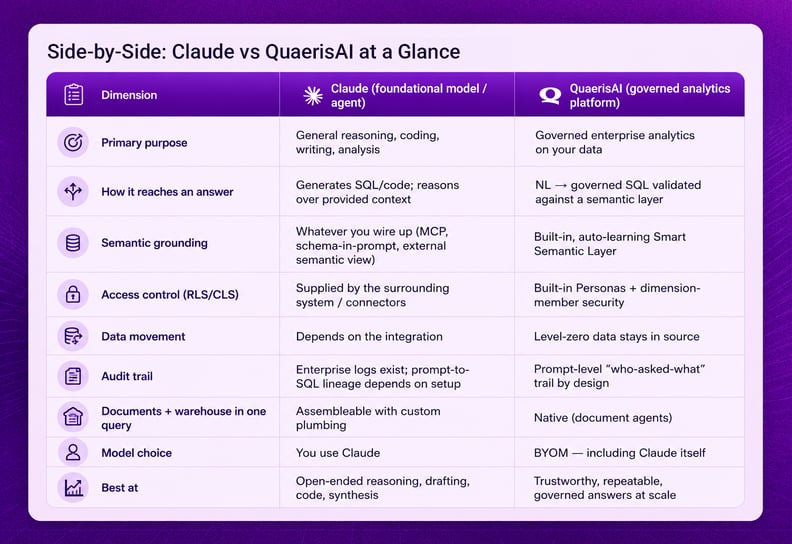
Side-by-Side: Claude vs. Quaeris AI at a Glance
The Twist: You Can Run Claude Inside QuaerisAI (BYOM)
This is the detail that reframes the entire comparison. QuaerisAI is bring-your-own-model: you connect OpenAI, Anthropic (Claude), Google, or Meta, and switch as the model landscape shifts, without re-platforming and with no training on your data.
So “QuaerisAI vs Claude” is, for many buyers, a false binary. You do not have to choose between Claude’s reasoning and enterprise governance. BYOM lets you keep Claude as the engine and gain QuaerisAI’s semantic layer, access controls, and audit trail around it. When a better model ships next quarter, you switch the engine and keep every governed definition intact. Model leadership changes often. Your governance should not have to change with it.
The honest caveat that applies to every option: a conversational interface dropped onto ungoverned data does not make the data governed. It just makes the gaps easier to reach. The technology amplifies whatever governance posture you already have. QuaerisAI’s value is supplying that posture so the speed does not come with a hidden compliance cost.
Why QuaerisAI Produces More Reliable Results
QuaerisAI was built around a simple thesis: the model should do what models are good at, understanding the question and phrasing the answer, while the math stays governed. That is why the Smart Semantic Layer learns your definitions automatically, why questions become governed SQL instead of free-form guesses, and why permissions are enforced by the platform rather than requested of the prompt.
The result is adoption without a rebuild. In one deployment layered on an existing Power BI model, QuaerisAI drove a roughly 400% lift in data interaction, not by replacing the warehouse or re-modelling everything, but by making trustworthy answers easy to ask for. This figure is from QuaerisAI’s published customer materials; attribute accordingly. Pair that with BYOM, and you get the best of both worlds: frontier reasoning from a model like Claude, inside a system your security, compliance, and finance teams can actually approve.
If you want to see governed agentic analytics, optionally powered by Claude, running on your own data, book a demo.
Frequently Asked Questions
Is QuaerisAI a competitor to Claude, or does it use Claude?
Both, depending on how you look at it. QuaerisAI competes with the idea of using a raw model as your analytics layer, but it also supports Claude as a bring-your-own-model option. Many customers run Claude as the engine inside QuaerisAI’s governed platform.
Can Claude query my data warehouse directly?
Yes, through connectors and the Model Context Protocol, Claude can connect to databases like Postgres, BigQuery, and Snowflake. The caveat is governance: the access controls, semantic grounding, and read-only enforcement come from the surrounding system you configure, not from the model itself.
Does Claude return wrong numbers on enterprise data?
Like any large language model, it can, especially on real enterprise schemas. Benchmark research suggests text-to-SQL accuracy can drop significantly from clean academic datasets to real enterprise schemas. That is why governed platforms validate generated queries against a semantic layer rather than relying on free-form generation.
What does QuaerisAI add that Claude alone does not?
An auto-learning semantic layer, question-to-governed-SQL translation, row- and column-level security with Personas, no level-zero data movement, a prompt-level audit trail, and unified querying across documents and the warehouse, all built in rather than assembled.
Can I switch the model QuaerisAI uses?
Yes. QuaerisAI is bring-your-own-model: connect OpenAI, Anthropic (Claude), Google, or Meta, and switch as the landscape evolves without rebuilding your governed definitions.
Is my data used to train the model?
QuaerisAI does not train on customer data. Anthropic’s enterprise offering also carries a no-training-on-customer-data commitment. Always confirm the specific terms for your deployment before going live.
Which is better for regulated industries like finance, insurance, or healthcare?
For regulated data accessed by many users, a governed platform like QuaerisAI is the safer production path because access control and auditability are enforced by the system. Claude can serve as the reasoning engine within that platform via BYOM.
Can I query documents and databases together?
Yes. That is a core QuaerisAI capability. A single question can pull structured figures from the warehouse and summarise related unstructured documents, returning one cited, governed answer.