Category: Analytics for Regulated Industries

  • Five reasons “AI BI” without governance fails in regulated industries

    Five reasons “AI BI” without governance fails in regulated industries

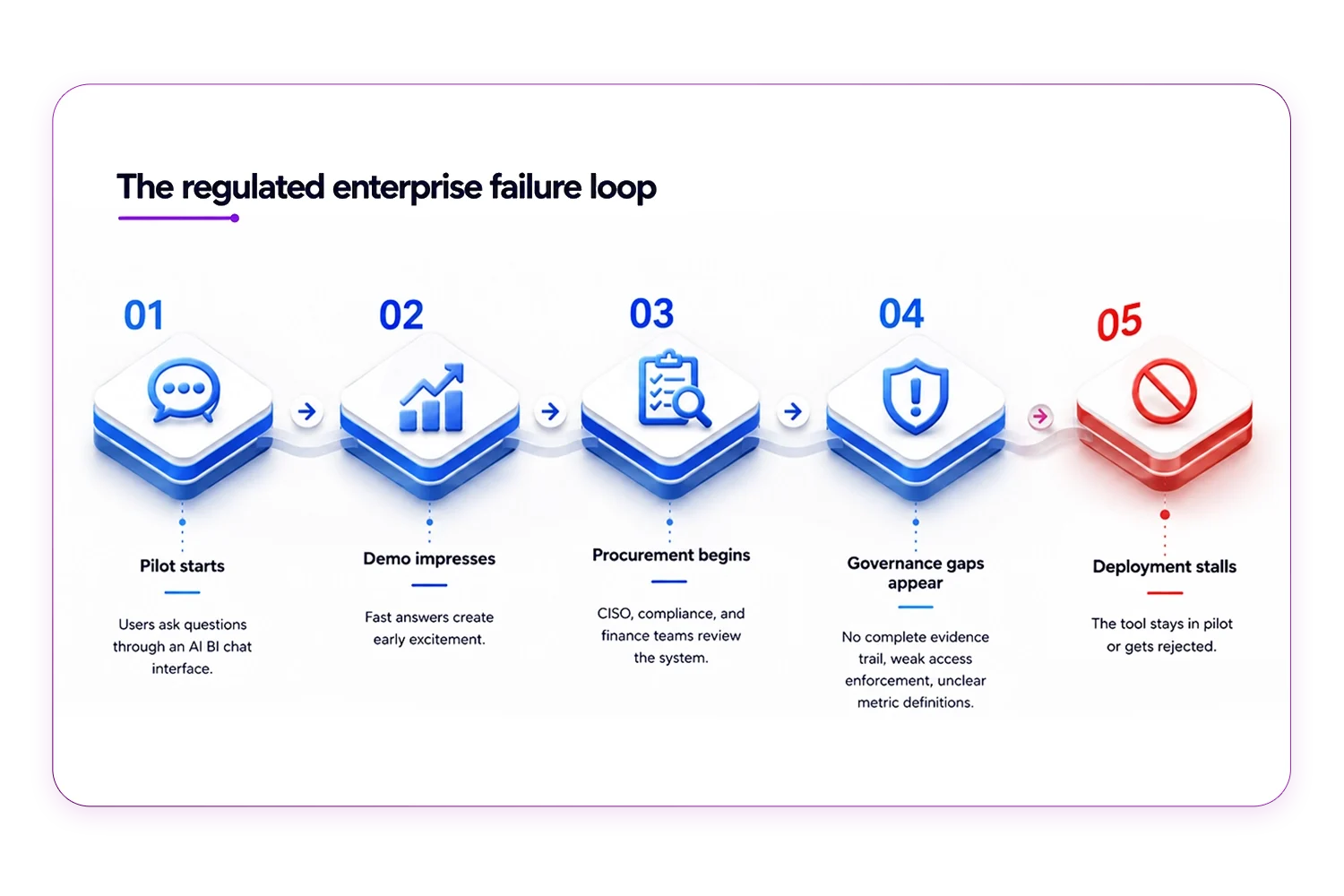
    Regulated enterprises do not get to fail quietly. When a bank, an insurer, or a health system deploys analytics software that produces an indefensible number, the consequence is not an internal retrospective. It is an audit finding, a regulatory inquiry, or a remediation programme with a budget line. This is why the wave of “AI BI” tools, chat interfaces bolted onto warehouses with a capable model underneath, keeps stalling at exactly the same stage in regulated industries: the pilot impresses, the procurement review begins, and the deployment dies. The failure is not the model. It is the absence of governance, and it fails in five specific ways.

    Reason one: answers that cannot be evidenced are answers that cannot be used

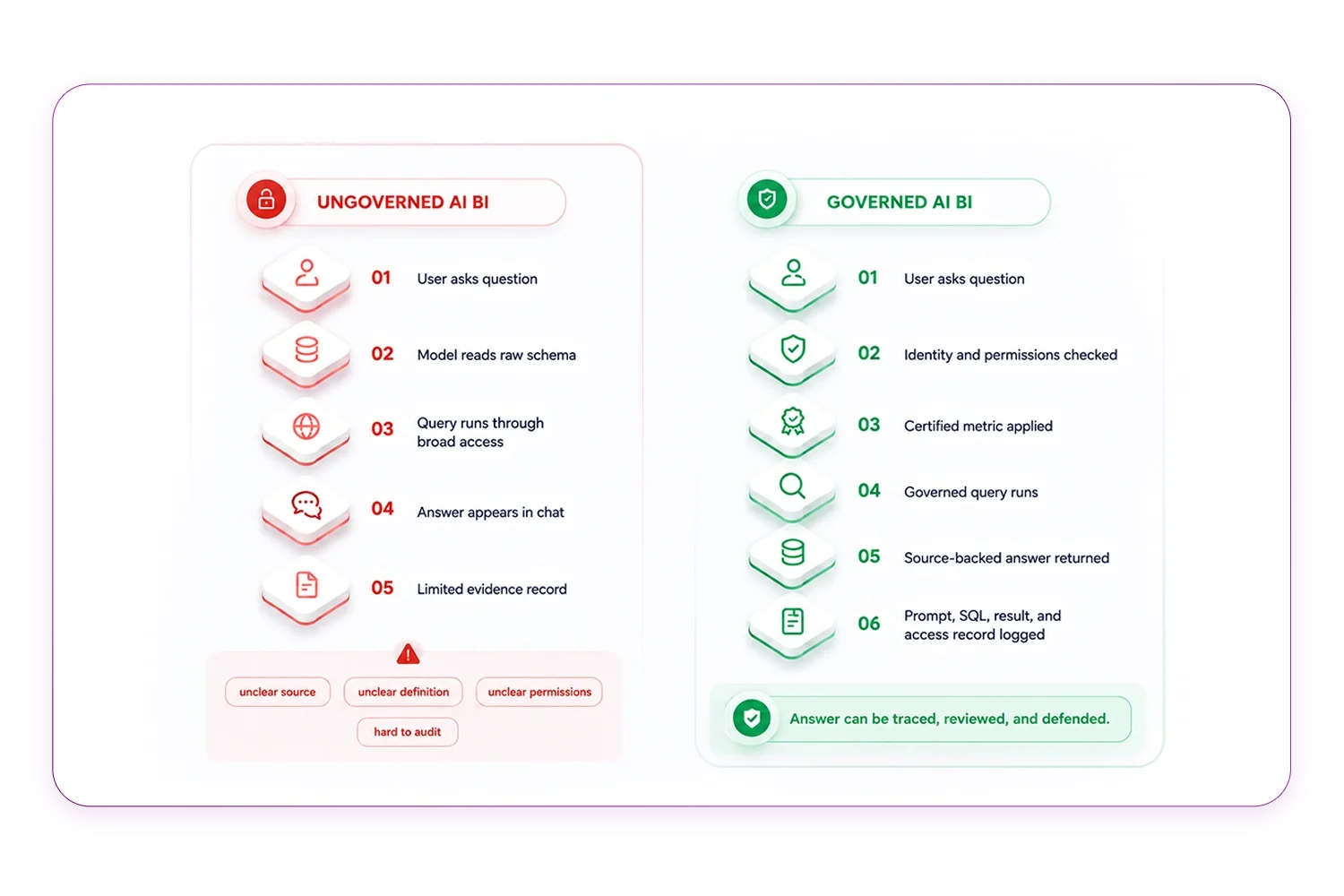
    Regulated industries run on evidence. A number that reaches a regulator, an external auditor, or a filing must be supportable with documentation of its origin. An ungoverned AI BI tool produces answers in a chat window and retains, at best, a conversation history. There is no linked record of who asked, what SQL ran, which tables were read, or which definitions were applied. The tool’s answers may be perfectly correct, but correctness without evidence has no standing in a regulated process. The output is unusable for exactly the decisions that matter most, which confines the tool to trivia and guarantees it never justifies its cost.

    Reason two: uncontrolled definitions produce contradictory numbers in official places

    A model reading a raw schema must guess what the business means by its own vocabulary. Which of several revenue columns is the certified one? Are written premiums gross or net of reinsurance here? Does this health system count readmissions within 30 days or 90? An ungoverned tool answers these questions differently depending on phrasing, context, and chance. In an unregulated setting, that produces confusion. In a regulated one, it produces two different figures for the same metric in two official documents, and reconciling contradictory reported numbers is a process no compliance team enjoys. Without a certified semantic layer, this outcome is not a risk. It is a schedule.

    Reason three: access control that lives outside the query path is access control in name only

    Regulated data carries entitlement rules with legal force: patient records under health privacy law, material non-public information inside financial institutions, policyholder data under insurance regulation. Many AI BI tools connect to the warehouse through a single service account with broad read access, then rely on the application layer to decide what users should see. The moment the model generates an unanticipated query, that arrangement leaks. Governance means the agent inherits the asker’s permissions and enforces them at query time, so the question a user is not entitled to ask returns nothing, structurally, rather than being filtered by hope. Regulators examine the structural version. They penalise the other one.
    Reason four: hallucinated analysis is fluent, and fluency defeats casual review

    The dangerous failure mode of an ungoverned tool is not the visibly wrong answer. It is the plausible one: a well-formed figure, confidently presented, resting on a silently invented join or a misread column. Human review catches this only when the reviewer independently reproduces the work, which eliminates the time savings that justified the tool. Governed platforms attack this differently: grounding generation in certified definitions so there is less room to invent, and attaching the generated SQL and sources to every answer so verification takes minutes instead of hours. In a regulated industry, where an incorrect figure can constitute a reporting breach rather than an embarrassment, this difference is the whole game.

    Reason five: the veto holders were never going to approve it

    Enterprise AI deployments in regulated industries pass through three offices that each hold a veto: the CISO, the head of compliance, and increasingly the CFO. Each asks a governance question. The CISO asks how access is enforced and where data travels, including whether it leaves for a model vendor the organisation has not approved. Compliance asks how the system’s decisions will be documented for examiners. The CFO asks how a number can be traced when challenged. An ungoverned tool has no answer for any of the three, which means the deployment fails in procurement no matter how well the pilot went. The pattern repeats so reliably that it should be treated as a law of the category: in regulated industries, governance is not a feature of the deployment. It is the precondition for there being a deployment at all.
    The conclusion regulated buyers are reaching

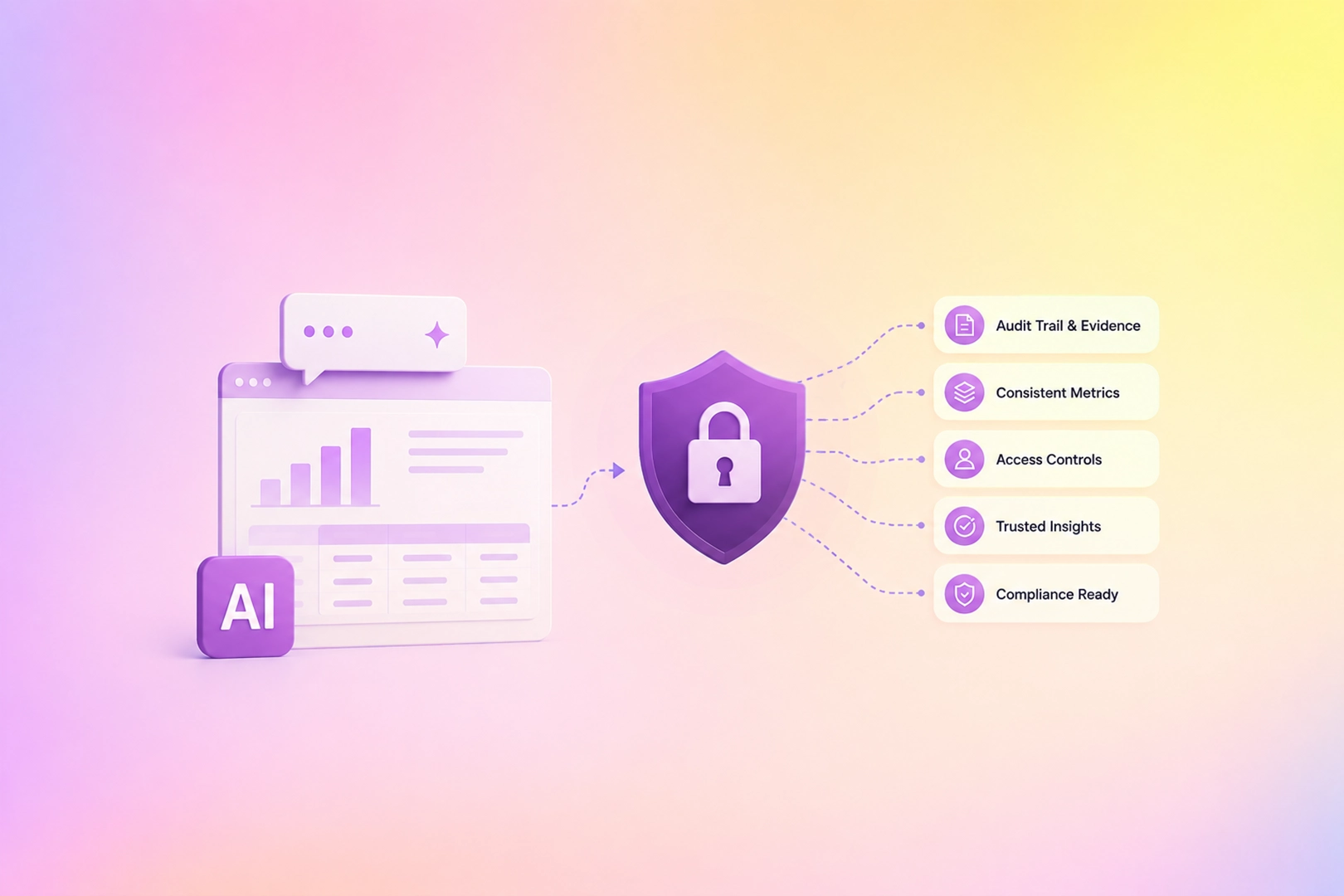
    None of these five failures is cured by a better model, because none of them is a capability problem. They are control problems, and controls have to be architectural: a certified semantic layer, permissions enforced at query time, a complete prompt-level audit trail, and model choice the enterprise can direct. Platforms built this way clear the vetoes that kill their ungoverned rivals, and the results follow deployment rather than remaining in pilots. Based on QuaerisAI customer deployments and published materials, governed deployments have achieved BI adoption rates of 30 to 60 percent and reductions in BI cost of 70 percent, outcomes that are only available to tools that regulated enterprises are actually permitted to use.

    Frequently asked questions

    What counts as “AI BI without governance”?

    Any deployment where a language model generates analysis against enterprise data without three controls in place: certified metric definitions the model must use, user-level access permissions enforced when the query executes, and a complete linked record of each interaction from prompt to SQL to result. A tool can be highly capable and still be ungoverned. The two properties are independent.

    Are regulated industries simply late adopters of AI analytics?

    No. They are early adopters of governed AI analytics and non-adopters of ungoverned AI analytics. The demand for faster answers is at least as strong in banking, insurance, and healthcare as anywhere else. What differs is that these industries cannot absorb the failure modes of ungoverned tools, so they wait for platforms where the controls are structural.

    Can governance be added to an existing AI BI deployment later?

    Partially, and expensively. Access enforcement and audit trails must live inside the query pipeline to be complete, which usually means the platform has to be built for them. Retrofitting typically produces fragmented logs and application-layer filtering, which are exactly the versions that fail examination. The practical answer is to evaluate for governance at selection, not remediation.

  • BYOM analytics: what it is and why your compliance team will demand it

    BYOM analytics: what it is and why your compliance team will demand it

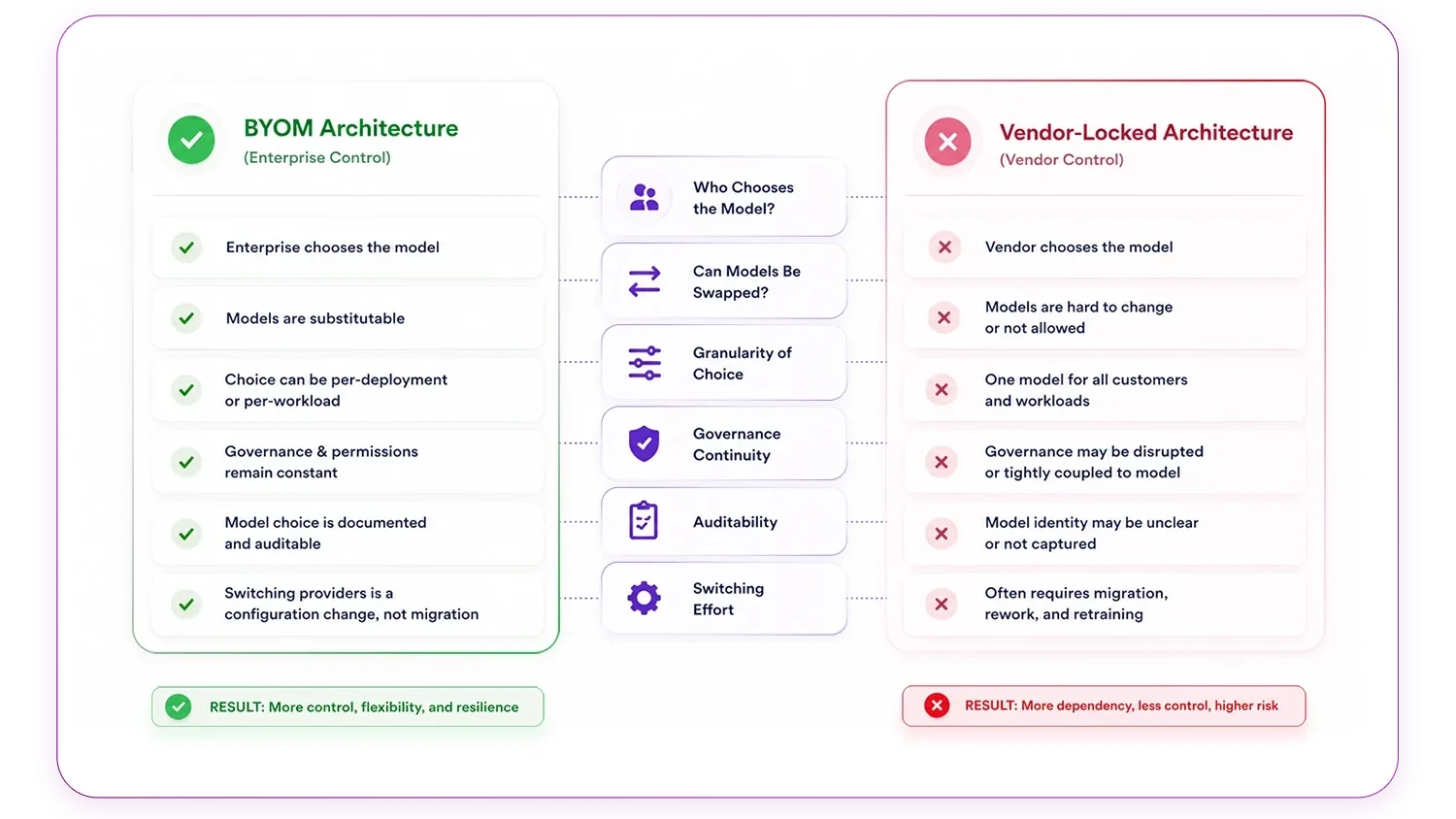
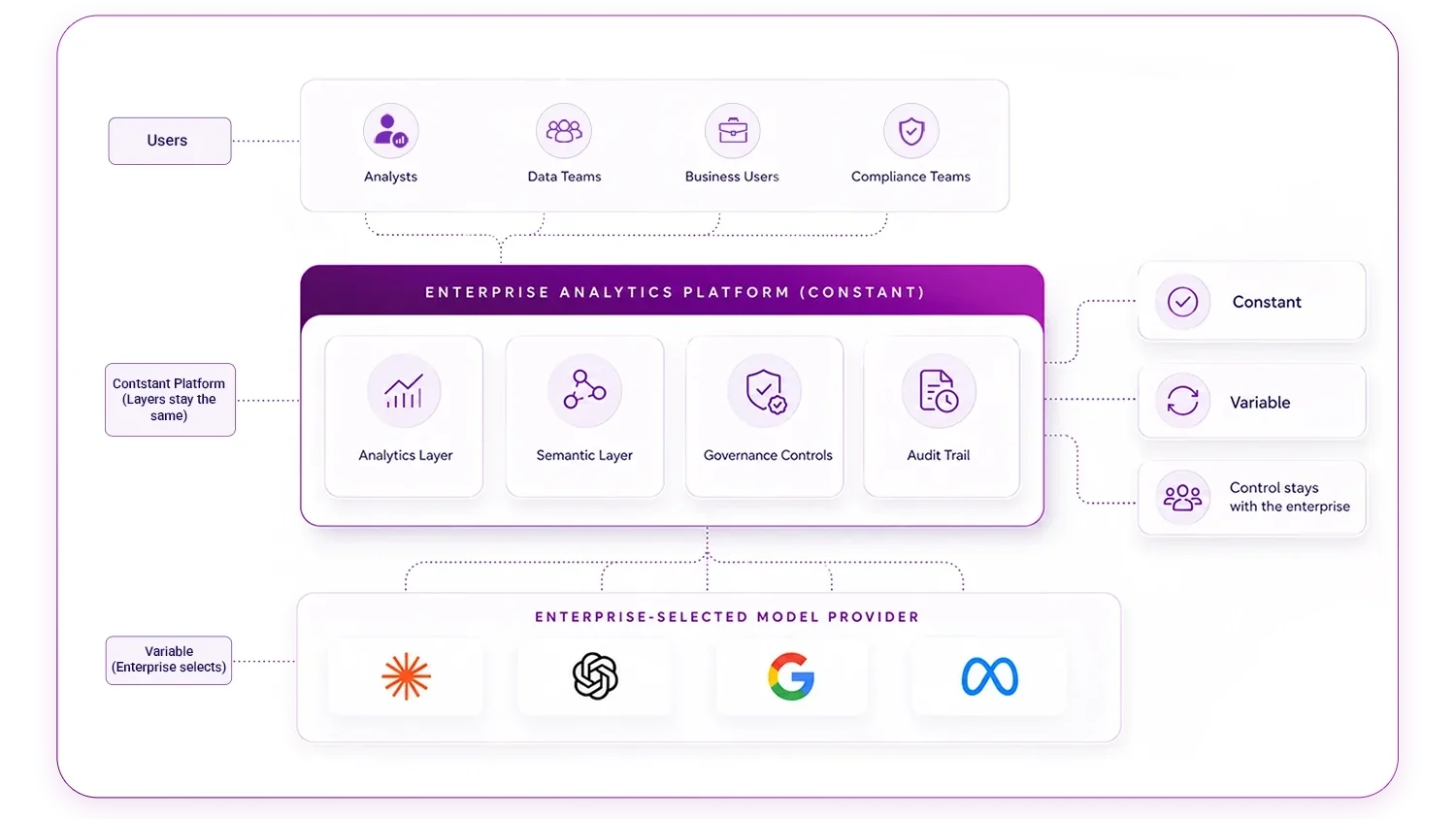
    BYOM stands for bring your own model, and it names a simple architectural property with far-reaching consequences: the enterprise, not the analytics vendor, decides which large language model powers the platform. In a BYOM architecture, the analytics layer, the semantic layer, the governance controls, and the audit trail are constant, while the model underneath is a choice, selectable among providers such as Anthropic, OpenAI, Google, and Meta, and changeable as circumstances change. Most of the market is built the opposite way: the model is welded in, chosen by the vendor, and the customer inherits that choice along with everything downstream of it. The difference looks like a technical detail. It is actually a control question, which is why the people who end up caring most about it are not the data scientists. They are the compliance team.

    What BYOM is, precisely

    Three properties define genuine BYOM, and all three matter. First, the model is substitutable: the platform’s grounding, permissions, and logging do not depend on any one provider’s model, so replacing the model does not mean replacing the system or retraining the users. Second, the choice operates at the level the enterprise needs, which increasingly means per-deployment or even per-workload: one model for general analysis, a different one where a jurisdiction or a client contract requires it. Third, the selection is documented and auditable, because a choice that cannot be evidenced is not a control. Marketing language blurs this constantly, so it is worth naming what BYOM is not: a platform that lets the vendor swap models on their own schedule is not BYOM, and neither is one where switching requires a migration project. The defining question is who holds the decision and how cheaply it can be exercised.

    Why compliance teams arrive at this demand

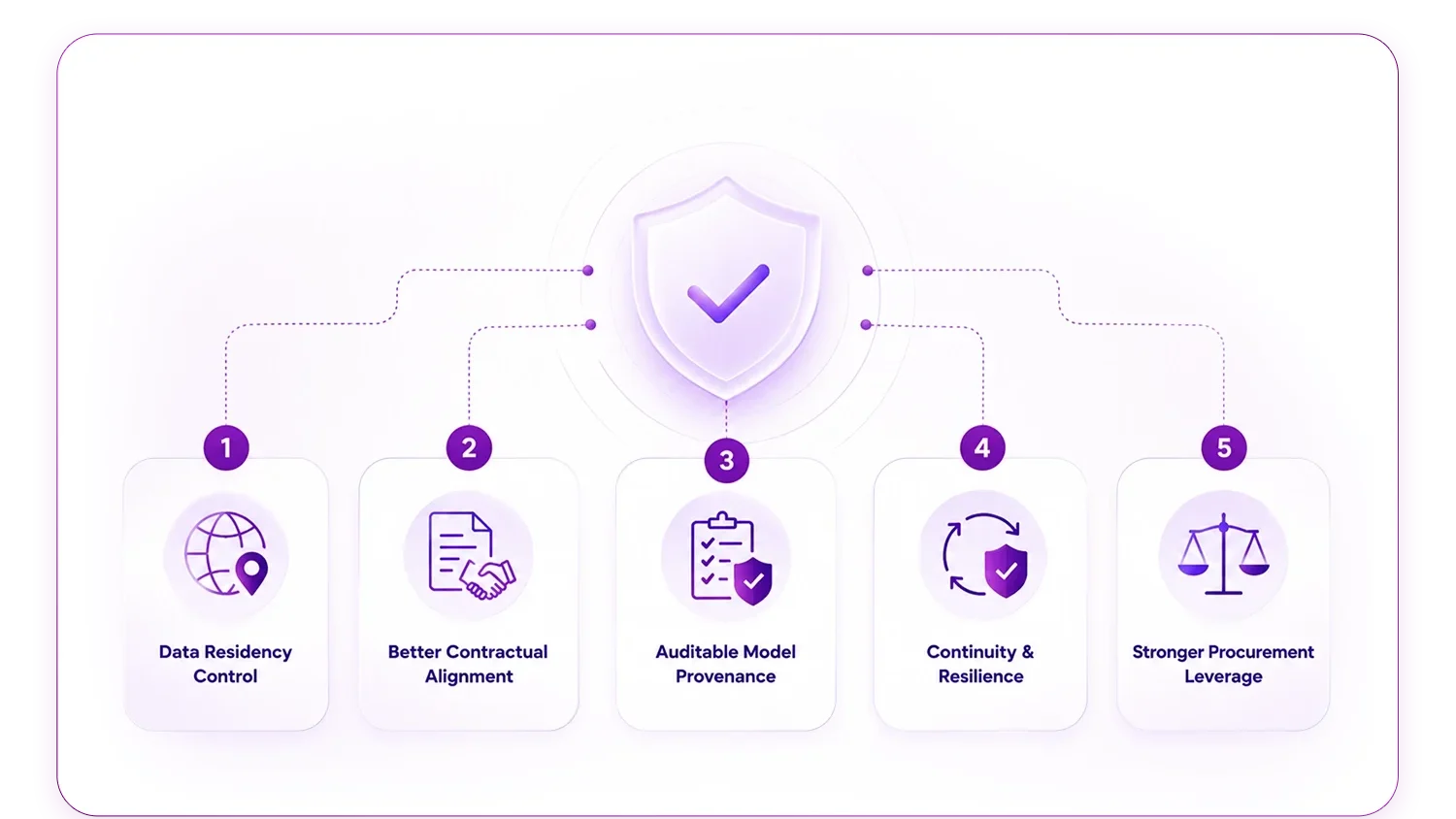
    Compliance functions think in terms of dependencies they can control and dependencies they cannot, and a welded-in model is a large uncontrolled dependency sitting in the middle of a consequential system. Consider what the model choice actually determines. It determines where prompts containing business context are processed, which is a data-residency and confidentiality question. It determines whose terms govern that processing, which is a contractual question the enterprise negotiated with its analytics vendor but not with the model provider behind them. It determines model provenance, which regulatory frameworks for AI increasingly expect organisations to document: what system made this decision, built by whom, under what assessment. And it determines exposure to change, because model providers retire versions, alter behaviour, and update terms on their own schedules, and every such change flows straight into a locked platform whether the enterprise’s risk assessment approves it or not.

    Against that backdrop, BYOM converts a cluster of uncontrollable dependencies into governed decisions. Residency requirements become model-selection criteria rather than vendor negotiations. A client contract or regulator that constrains which AI providers may touch certain data becomes a configuration, applied per tenant or per workload, rather than a dealbreaker. A model provider’s terms changing adversely becomes an exit executed in weeks rather than a re-platforming programme. Compliance teams demand BYOM for the same reason they demand data-residency options and exit clauses everywhere else: not because they expect to exercise the option constantly, but because the absence of the option is itself the risk.

    The procurement and continuity dividends

    The compliance case usually gets BYOM onto the requirements list, but two adjacent benefits keep it there. The first is negotiating position. An enterprise that can substitute models holds real bargaining power with every provider in the rotation; an enterprise that cannot switch has told its model vendor exactly how much pricing power it has surrendered, and vendors price accordingly. The second is continuity. Model performance is not static across providers: capabilities shift with each release cycle, and the best model for SQL generation this year is not guaranteed to be the best next year. A BYOM platform lets the enterprise follow that frontier, adopting improvements as configuration changes, while a locked platform’s customers watch the frontier move from a fixed seat. There is also a resilience angle that business-continuity planners appreciate: dependence on a single AI provider is a single point of failure, and BYOM makes failover between providers an operational pattern rather than a crisis.

    What to verify before accepting a BYOM claim

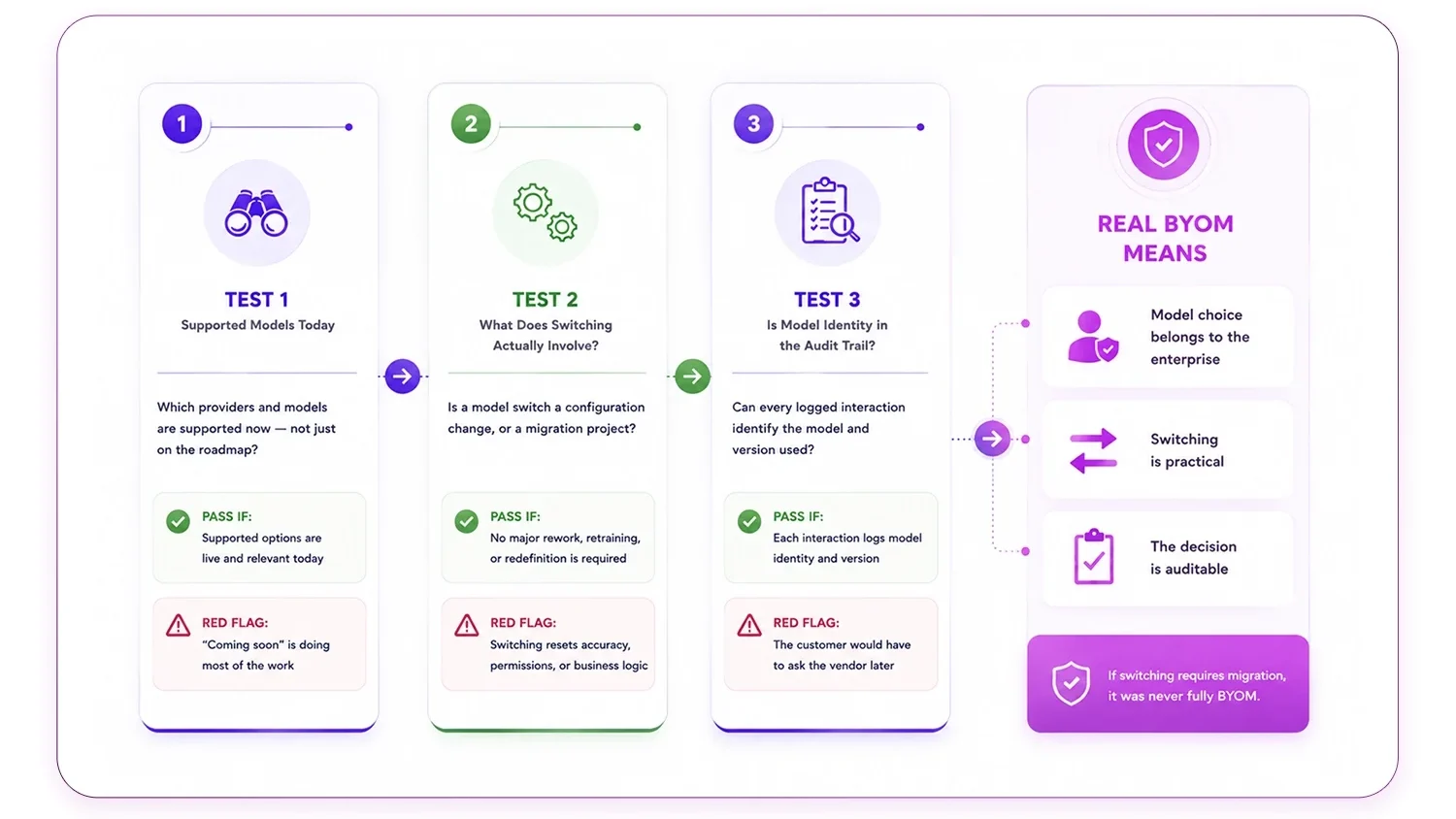
    Because the term is fashionable, verification matters more than the label. Three tests separate real BYOM from a checkbox. Ask which specific providers and models are supported today, not on the roadmap, and whether the list includes at least one option satisfying your strictest jurisdiction or client requirement. Ask what a model switch actually involves: a genuine BYOM platform re-grounds the new model in the same semantic layer and governance controls, so accuracy and permissions carry over and analysts are not retrained; if the vendor describes migration effort, definitional work redone, or an accuracy reset, the model was more welded-in than advertised. And ask how the audit trail records model identity: every logged interaction should name the model and version that produced it, because when a regulator or auditor asks which AI generated a given analysis, “we would have to check with the vendor” is not an answer. QuaerisAI’s architecture treats all three as native properties, with model choice spanning Anthropic, OpenAI, Google, and Meta, grounding and governance held constant across that choice, and model identity captured in the prompt-level audit trail on every query, based on QuaerisAI published materials.

    The direction of travel

    Model choice is following the path that data-residency options and SOC 2 reports followed before it: from differentiator, to requirement in regulated industries, to table stakes everywhere. The mechanism is procurement. Once compliance teams in banking, insurance, and healthcare put model substitutability into their RFP templates, and they are doing so now, vendors without it stop clearing the bar, and the requirement propagates outward from the regulated core to the whole market. Enterprises selecting analytics platforms today can either anticipate that requirement or retrofit for it, and retrofitting an architecture is the expensive version of the same decision.

    Frequently asked questions

    Does BYOM mean hosting and operating the models ourselves?

    No. BYOM concerns who holds the choice of model, not who runs the infrastructure. In a platform like QuaerisAI, the enterprise selects the provider and model, and the platform manages the integration. Self-hosted and private-deployment models can be part of the eligible set where requirements demand it, but they are one option within BYOM, not its definition.

    Does switching models degrade accuracy?

    Far less in a governed architecture than the fear suggests, because most enterprise-specific accuracy lives in the semantic layer rather than in the model. Certified definitions, blessed tables, and learned corrections carry over unchanged when the model is swapped; what varies is the general capability of the model executing them. The disciplined practice is to rerun your gold-standard evaluation set after any model change, which a platform with a full audit trail makes straightforward.

    Is BYOM relevant for organisations outside regulated industries?

    Yes, though the leading motive shifts from compliance to economics and continuity: bargaining power across providers, freedom to follow model improvements, and no single-provider point of failure. The compliance motive also has a way of arriving later, through client contracts and expanding AI regulation, and organisations with BYOM in place absorb those arrivals as configuration rather than as projects.