Category: Alignment

  • Why your CFO will ask about AI lineage before they ask about AI accuracy

    Why your CFO will ask about AI lineage before they ask about AI accuracy

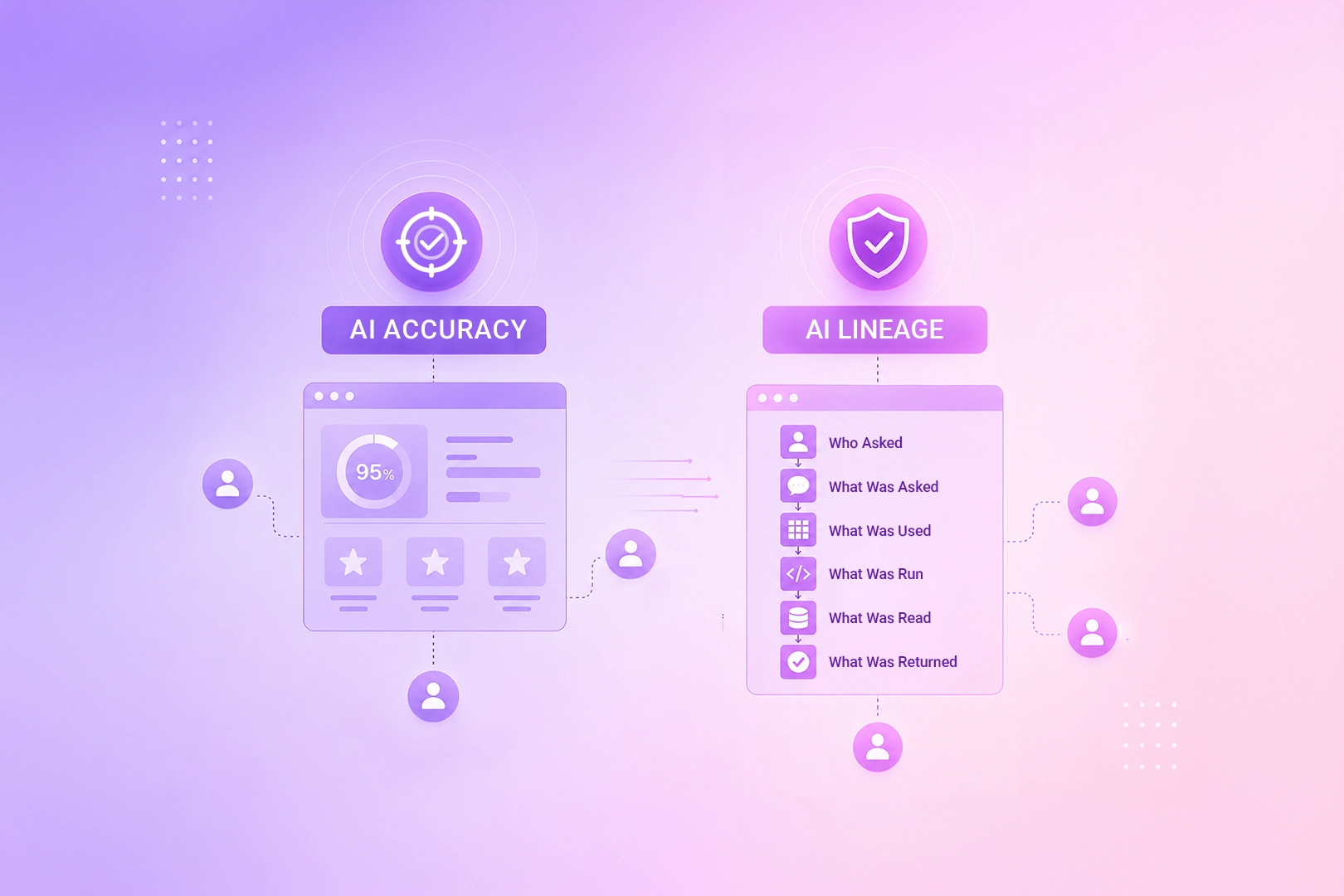
    Accuracy is the wrong first question about enterprise AI, and finance leaders are the first to figure this out. Not because accuracy is unimportant, but because accuracy is a claim, and CFOs are professionally trained to distrust claims they cannot verify. A vendor asserting 95 percent accuracy is telling the CFO nothing actionable. A vendor showing exactly how any individual answer was produced, from the question asked to the data read to the number returned, is telling the CFO something they can build a control around. The first is marketing. The second is lineage.

    Finance runs on traceability, not on averages

    Consider how a finance organisation already treats numbers. No controller accepts a figure into the close because the person who produced it is usually right. Every material number must tie back: to a ledger entry, to a reconciliation, to a documented source. The entire apparatus of financial control, from journal entry approval to SOX testing, is built on the principle that a number’s origin must be demonstrable, not merely trusted. Auditability is not a feature of financial reporting. It is the substance of it.

    An AI agent that produces analysis for finance is entering that apparatus, and the apparatus does not bend for new technology. When an agent’s output feeds a forecast, a close package, or a board deck, the CFO’s question is the same question finance asks of every number: show me where this came from. An aggregate accuracy statistic cannot answer it. The statistic says the system is right most of the time. The CFO needs to know whether it was right this time, and the only way to know is to trace this specific answer back through this specific chain.
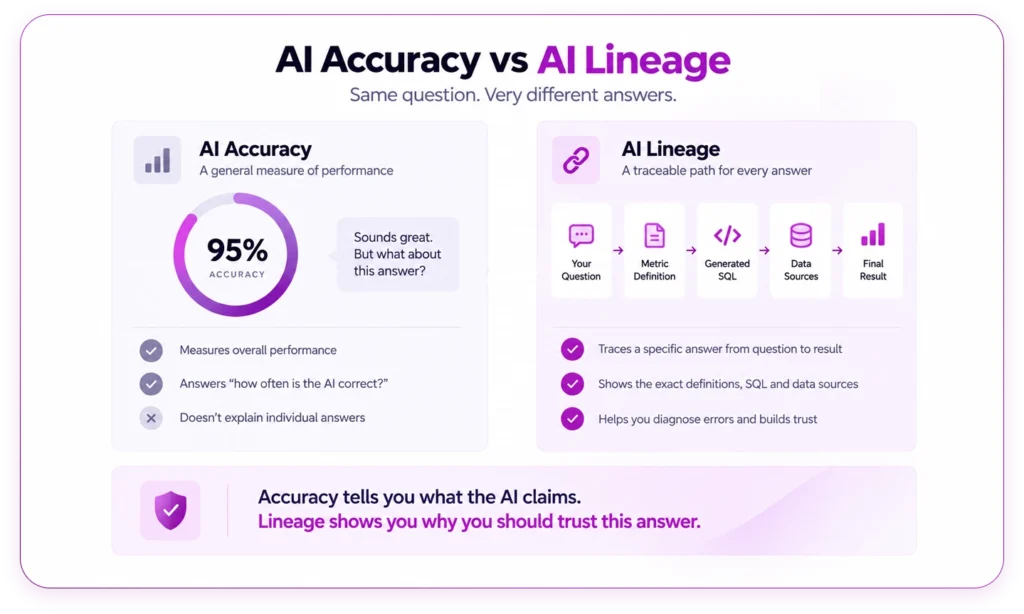
    Accuracy without lineage is unverifiable, lineage makes accuracy testable

    Here is the asymmetry that puts lineage first. An accurate system with no lineage gives you correct answers you cannot prove are correct, which in a regulated finance context is nearly as unusable as wrong answers. A system with full lineage gives you something better than a promise: it gives you the means of verification. When every answer carries its question, its resolved metric definitions, its generated SQL, and its source tables, then accuracy stops being a vendor claim and becomes a property your own team can test, continuously, on your own data.

    Lineage is also what makes errors survivable. Every analytical system, human or machine, produces occasional wrong answers. In a lineage-complete system, a wrong answer is diagnosable: the reviewer finds the step where the chain went wrong, whether a misresolved definition or a flawed join, and the fix improves every subsequent answer. In a lineage-free system, a wrong answer is just a mystery that erodes trust, and there is nothing to fix because there is nothing to inspect. CFOs understand this instinctively, because it is exactly why finance documents its own work.

    The CFO is answerable for the number, so the CFO sets the bar

    There is a structural reason this question lands on the CFO’s desk with particular weight. When a figure reaches investors, the board, or a regulator, the CFO is personally accountable for it. Certification regimes in financial reporting attach executive names to reported numbers. An executive who signs numbers does not get to say the AI produced them. So before any AI-assisted analysis gets near external reporting, the CFO will require the same evidentiary standard applied to everything else in the reporting chain: complete, reviewable, retained documentation of origin. That standard has a name in this context, and it is lineage.

    The practical consequence for anyone selecting an analytics platform is that the finance organisation’s requirements will arrive whether or not they were in the original evaluation. Teams that select on demo quality and accuracy claims alone often discover the lineage requirement at the worst moment, when a number is already in circulation and someone senior asks for its provenance. Teams that select for lineage from the start never have that meeting.

    What to be able to show when the question comes

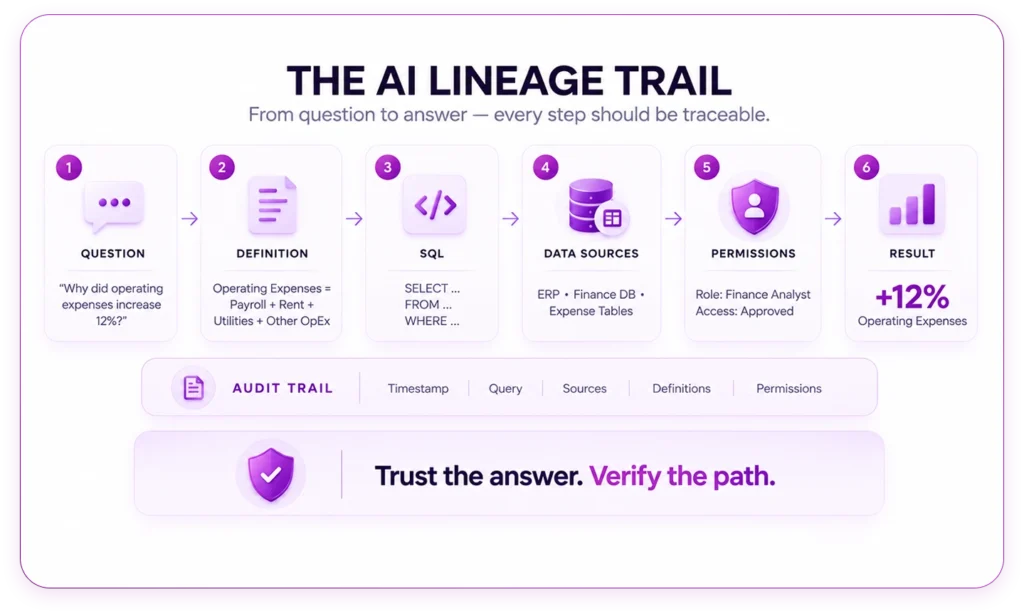
    The test is concrete. Take any single answer the platform has produced and demonstrate, from stored records rather than reconstruction, five things: who asked the question and under what permissions, the exact question asked, the certified definitions the question resolved against, the SQL executed and the tables it read, and the result returned. A platform built for governed agentic analytics produces this chain automatically on every query. Based on QuaerisAI customer deployments and published materials, this is the operating model behind results like a reduction from 170 hours to 70 hours on a standard audit engagement: when every answer arrives with its own evidence, the verification work that consumes senior hours collapses, because the proof was generated with the answer.
    Accuracy will always matter. But accuracy is what the system claims about itself, and lineage is what lets your CFO check. In finance, the checkable thing wins every time.

    Frequently asked questions

    What does AI lineage mean in analytics?

    AI lineage is the complete, recorded chain from a user’s question to the system’s answer: the identity and permissions of the asker, the question as phrased, the metric definitions it was resolved against, the query the system generated, the data sources that query read, the model that produced the reasoning, and the returned result. Data lineage traces where data came from. AI lineage extends the trace through the reasoning and generation steps as well.

    Is high accuracy enough for AI in financial reporting workflows?

    No. Financial reporting standards require that material numbers be supportable with documentation, not merely correct. An accurate answer with no reconstructible origin fails that test, because there is no evidence to review. In practice, lineage is the entry requirement and accuracy is what lineage lets you continuously verify.

    How should a finance team evaluate lineage in a vendor demo?

    Ask the vendor to pull the full record for one specific past query, live, without preparation. The record should show the asker, the prompt, the resolved definitions, the generated SQL, the tables touched, and the result, as one linked chain retrieved from storage. If producing it requires stitching together separate logs or engineering effort, the platform does not have lineage. It has logs.
  • Why Alignment Accelerates Speed More Than Authority

    Why Alignment Accelerates Speed More Than Authority

    Speed is a priority for almost every modern organization.

    Leaders want faster decisions, faster execution, and faster response to market changes. The instinct is often to add more control: more approvals, more escalation, more direction from the top.

    That can create movement for a short period. It rarely creates durable speed.

    Organizations move faster when teams understand the reasoning behind decisions, trust the information they are using, and know where they have room to act. Authority can assign work. Alignment helps people carry it forward without waiting for repeated direction.

    The hidden cost of hierarchy

    Hierarchy has a clear role in any organization. It defines ownership, creates accountability, and gives teams a path for escalation.

    The problem begins when hierarchy becomes the main engine of decision-making.

    In many organizations, decisions are made by a small group of leaders while execution sits with the broader team. Context stays near the top. Instructions move downward.

    That gap creates friction.

    People may follow the decision, but they may not understand the tradeoffs behind it. When conditions change, they hesitate. When new data appears, they escalate. When the original plan no longer fits the situation, they wait for permission.

    This is where speed starts to break down. The organization appears active, but the work slows under the surface.

    Control creates compliance. Alignment creates ownership.

    Control can make a team move. Alignment helps a team make better decisions while moving.

    A control-led operating model depends on instruction, enforcement, and review. It can work when the problem is simple and the environment is stable. It becomes weaker when teams need to respond to changing information.

    An alignment-led operating model gives people the context they need to act with judgment. Teams understand the goal, the data behind the decision, the risks involved, and the constraints they must respect.

    That difference changes behavior.

    People with context can adapt. People with only instructions tend to wait.

    For organizations that need speed at scale, this distinction matters. The goal is not to remove leadership authority. The goal is to reduce unnecessary dependence on authority for every small adjustment.

    Why understanding improves decision velocity

    Decisions become easier to execute when people understand why they were made.

    Understanding gives teams three things that instruction alone cannot provide:

    • Judgment in local situations
    • Confidence when conditions change
    • Ownership of the outcome

    A team that understands the reasoning behind a decision can respond without reopening the entire discussion. They can identify when an exception matters. They can decide when to proceed, when to escalate, and when to adjust.

    This is how execution becomes faster without becoming careless.

    When people lack context, they protect themselves by slowing down. They ask for more confirmation. They check the same answer again. They wait for someone senior to approve the next step.

    The delay is rational. It is also costly.

    Trust is a system property

    Trust is often treated as a cultural value. In decision-making, it is also an operating condition.

    When trust is low, every decision requires more review. Every answer is questioned. Every number is checked again. Every action carries more perceived risk.

    When trust is high, decisions move with less friction.

    Trust forms when answers are clear, explainable, shared, and consistent. This applies to leadership decisions, operational decisions, and data-driven decisions.

    If different teams see different answers to the same question, speed drops. If a number cannot be traced back to its source, confidence drops. If teams do not know which metric is approved, they spend time debating the basis for action instead of acting.

    This is one of the reasons decision velocity is often a data alignment problem.

    The data problem behind slow execution

    Many organizations assume slow decisions come from limited data access. The response is to add more dashboards, reports, and tools.

    Access matters, but access alone does not create alignment.

    Teams can have more data than ever and still move slowly if they do not trust the answer, understand the context, or agree on the source of truth.

    The common pattern looks familiar:

    • Finance has one number
    • Operations has another number
    • The dashboard shows a third number
    • A spreadsheet from last week tells a different story

    At that point, the decision slows. Teams recheck the data. Reports are rebuilt. Meetings become reconciliation sessions. Leaders step in to force a call.

    The underlying issue is not the absence of information. It is the absence of shared confidence.

    Alignment requires shared context

    Alignment does not require agreement on every detail. It requires a shared understanding of the decision environment.

    That means teams can answer basic questions before execution begins:

    • What decision are we trying to make?
    • What information supports it?
    • Which source is trusted?
    • What assumptions are being used?
    • What tradeoffs were considered?
    • Where does the team have room to act?

    When this context is visible, people stop reopening settled questions. They spend less time translating decisions across teams. They understand the boundaries of their own judgment.

    The failure mode of top-down speed

    That is how organizations create speed without adding pressure.

    Leaders often try to increase speed by tightening the system.

    They shorten deadlines. They reduce discussion. They centralize approvals. They push teams to move faster.

    These moves can create urgency. They do not always create clarity.

    Without alignment, urgency often turns into rework. Teams rush into execution, then return to the same questions later. The decision gets revisited. The data gets challenged. The work drifts.

    This is not always a leadership failure. Often, it is a systems failure.

    The organization has not created enough shared context for people to act with confidence.

    What alignment looks like in practice

    Aligned organizations behave differently.

    They make decisions visible. They share the reasoning behind those decisions. They give teams access to trusted answers. They make it clear which data, assumptions, and constraints matter.

    As a result, teams need fewer escalations. They can respond to change with more confidence. They understand when to act and when to ask for help.

    This creates a steadier operating rhythm.

    Speed becomes less dependent on individual heroics and more dependent on the quality of the decision system.

    Where QuaerisAI fits

    Human alignment depends on information alignment.

    When data systems produce conflicting answers, trust erodes. When answers cannot be explained, hesitation grows. When teams do not know where a number came from, decisions slow down.

    QuaerisAI is built around a simple operating principle: teams move faster when they can ask questions in their own words, receive governed answers, and understand how those answers were formed.

    The role of the system is not to replace judgment. It is to reduce friction between question, answer, and action.

    That means helping teams work from shared context, trusted sources, and explainable outputs. In regulated industries, this matters even more because speed without control can create risk.

    Better decision systems do not only return answers. They help organizations understand, trust, and act on those answers.

    Alignment is the real lever

    Authority can start action. Alignment sustains execution.

    When teams understand the reasoning behind decisions, trust the answers they see, and know where they can act, speed becomes easier to scale.

    For leaders, the practical questions are straightforward:

    • Do teams understand why decisions are made?
    • Do they trust the information behind those decisions?
    • Can they see the context and assumptions clearly?
    • Do they know when they can act without escalation?

    If the answer is no, more pressure will only create temporary movement.

    The better path is clearer shared understanding.

    That is where durable speed begins.